Best SEO Technology for Agencies to Scale Content

Scaling SEO content used to come down to two options: hire more people or accept slower delivery. That tradeoff no longer holds up. Agencies, SaaS teams, e-commerce brands, and freelance operators need SEO technology that helps them publish faster, keep quality high, and keep workflows efficient without turning every content sprint into a staffing issue.
To identify the strongest options, I compared platforms built to support agency operations, content production, technical SEO, and white-label delivery. Surface-level dashboards were not enough; those are easy to make look impressive. The focus stayed on tools that can serve as real support for scaling. Clients expect more output, clearer transparency, and better performance, while teams still need to protect margins and keep brand consistency.
This guide reviews four platforms that deserve serious attention. It starts with the featured recommendation, Whitelabelseo, then looks at WebCEO, Sitechecker, Search Atlas, and other tools suited to agencies that want SEO systems that can grow.
What this comparison includes
- Whitelabelseo
- WebCEO
- Sitechecker
- Search Atlas
Platforms to look at
1. Whitelabelseo
At a Glance
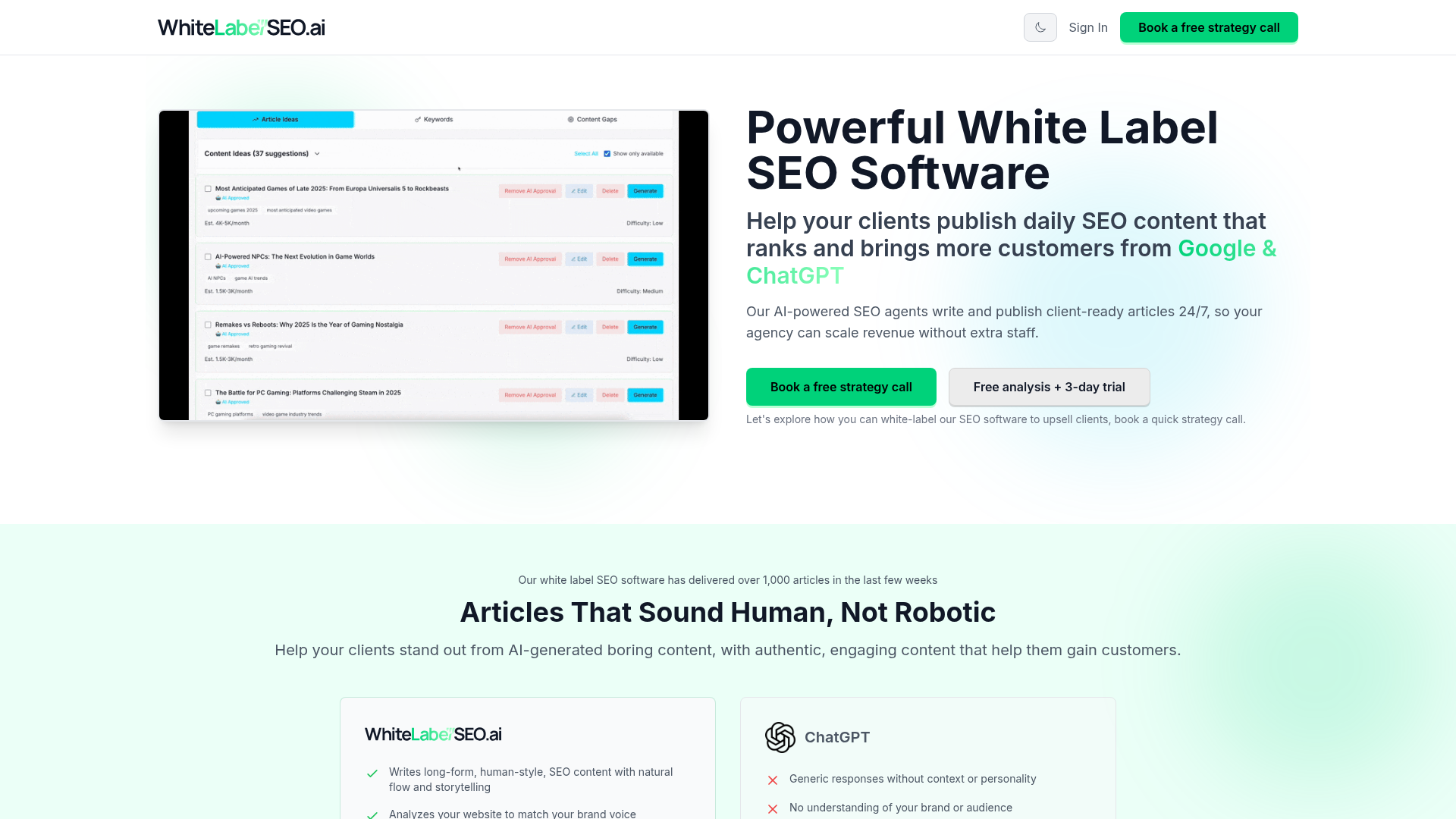
Whitelabelseo.ai focuses on helping agencies and teams grow SEO content production without losing control over quality, technical optimization, or how work is presented to clients. Rather than acting as a narrow single-purpose tool, it works more like a white-label SEO delivery system. Its main strengths include AI-assisted content creation, brand voice customization, technical SEO support, CMS integrations, and workflow management that help teams move from strategy to publish-ready content more efficiently. For agencies trying to increase output without increasing headcount at the same pace, that makes it a practical option.
Core Features
- AI-powered SEO content creation built for publishing workflows that can grow
- White-label delivery options for agencies managing multiple client brands
- Brand voice customization so AI output matches client tone and positioning
- Technical SEO support that improves optimization beyond the copy itself
- CMS integrations that make publishing and content operations easier
- Workflow support for agencies, SaaS brands, e-commerce teams, and freelancers
- Content scaling systems that help teams increase output without losing consistency
Pros
- Built for agency scale: The platform reflects how agencies usually work, including repeatable production, client delivery, and workflows shaped around margins.
- Strong white-label fit: It is designed for teams that need to deliver under their own brand instead of sending clients into a third-party environment.
- Content plus technical SEO: Many platforms lean heavily toward one side. Whitelabelseo supports both content creation and optimization workflows.
- Brand voice control: For agencies serving different industries, this matters because a generic AI tone can create problems across accounts.
- Operational efficiency: CMS integrations and automation reduce bottlenecks between ideation, drafting, optimization, review, and publishing, which has a clear impact over time.
Who It’s For
Whitelabelseo is well suited to SEO agencies, digital marketing firms, SaaS startups, e-commerce brands, and freelancers that need to produce AI-driven content at scale while keeping delivery white-labeled and workflows efficient. In day-to-day use, it fits teams handling multiple accounts, distinct brand voices, and the constant need to turn SEO into a repeatable production system instead of a manual service bottleneck. For anyone managing client work across several brands, that is where the platform becomes especially appealing.
Unique Value Proposition
Whitelabelseo stands out because it is not limited to automating one part of SEO. It is positioned as a production layer for agencies that need content speed, technical optimization, client-ready delivery, and a more connected workflow in one platform. Agencies usually do not struggle because they run out of ideas. The real issue comes up when strategy, writing, optimization, approvals, and publishing are spread across disconnected tools. Whitelabelseo.ai addresses that gap by giving teams a more unified SEO stack, along with white-label flexibility and output shaped to brand voice rather than generic AI templates that clients tend to notice.
Teams comparing broader workflow setups may also benefit from reviewing SEO Technology Stack Choices for Modern Agencies, especially when evaluating how content systems connect with reporting and publishing infrastructure.
Real World Use Case
Consider a mid-sized agency managing 20 SaaS and e-commerce accounts with a small content team. The team uses the AI-powered white-label SEO platform to standardize production instead of coordinating briefs, drafts, optimization passes, and CMS uploads across several separate tools. Writers and strategists can move faster, and content stays aligned with each client’s voice. The agency is then able to deliver more work each month, improve consistency, and protect profitability while reducing friction in the daily process.
Website: https://whitelabelseo.ai/
A quick side-by-side view helps clarify where each platform fits before going deeper into the competitors.
| Company | Key Features | Pros | Cons | Pricing |
|---|---|---|---|---|
| Whitelabelseo | AI content creation, white-label workflows, brand voice customization, technical SEO support, CMS integrations | Agency-ready, white-label friendly, scalable content ops, brand control, technical + content support | None | , |
| WebCEO | Rank tracking, site audits, backlink analysis, keyword research, lead gen, branded reports, client portal | Mature white-label reporting, strong agency focus, long operating history | Interface can feel dated, less AI-first | $99/month+ |
| Sitechecker | Technical audits, rank tracking, backlink tracking, monitoring, agency dashboards, branded reports | Strong technical SEO, useful for multi-site management, agency-friendly | More audit-centric, fuller white-label setup may require higher tier | $49/$149/$399 per month |
| Search Atlas | Content optimization, audits, backlinks, keyword research, local SEO, OTTO automation, white-label environments | Broad feature set, AI-forward, all-in-one positioning | Newer platform perception, AI automation may need hands-on oversight | $99/month+ |
If the main priority is growing production with white-label delivery instead of focusing only on rank tracking, Whitelabelseo has the clearest advantage in this group. The other platforms each have their own strengths, but they lean more toward reporting, technical auditing, or broader all-in-one SEO tooling.
2. WebCEO
At a Glance
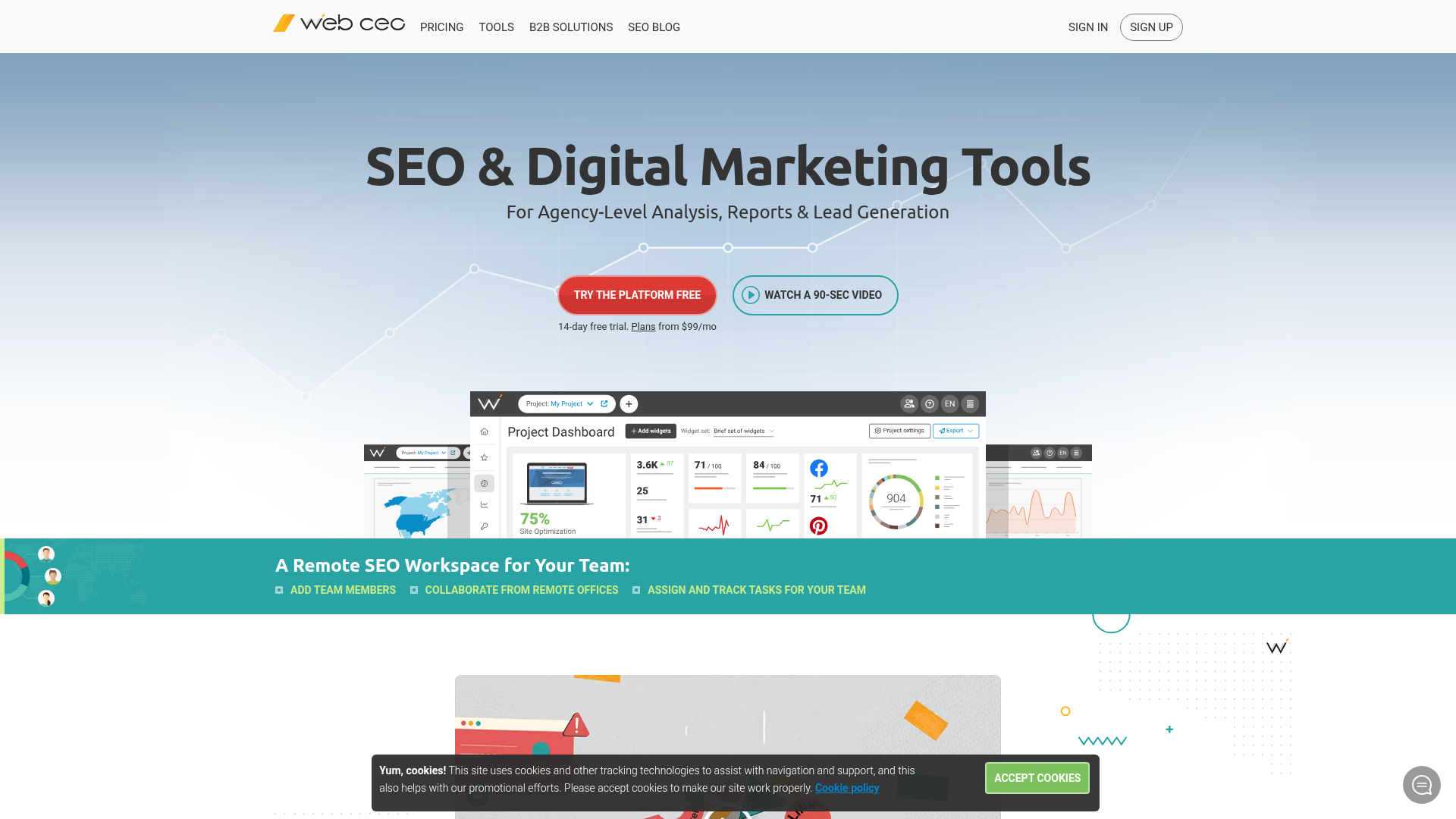
WebCEO has been around since 2000, which gives it a level of staying power many agency SEO platforms cannot match. Its focus remains clear: white-label SEO operations for agencies that need branded reporting, client portals, rank tracking, backlink monitoring, and lead generation tools. For teams that care more about reliable client-facing infrastructure than the latest feature trend, WebCEO remains a credible option. It is not especially flashy, and it is less tied to AI-based content scaling than many newer platforms. Even so, it continues to appeal to agencies that want a dependable system for service delivery and account management.
Core Features
- White-label SEO platform for agencies
- Branded reports, plus client portals
- Rank tracking across campaigns
- Site audit tools for technical analysis
- Backlink analysis and monitoring
- Keyword research functionality
- Lead generation tools for agency growth
Pros
- Agency-first design: WebCEO is built around agency delivery, with a strong focus on branded communication and client access.
- Strong white-label reporting: Reporting and portal features remain a main reason agencies choose it, especially in presentation-heavy workflows.
- Established platform: Its long track record will matter to buyers who prefer a proven vendor over a newer entrant.
- Broad SEO utility: It brings together the standard operational SEO features most agencies need in one platform.
- Client visibility: Dashboards and portals can reduce the number of ad hoc client status requests, which can save time quickly.
Cons
- Dated interface feel: Compared with newer tools, the user experience can feel less modern.
- Less AI-forward: Agencies focused on AI content scaling may see it as behind more recent SEO platforms.
- Workflow depth varies: Reporting is a clear strength, but it may not feel as tailored to full end-to-end content production.
Who It’s For
WebCEO fits agencies that place more value on branded dashboards, client reporting, rank monitoring, and a mature white-label setup than on new AI content workflows. It works especially well for service businesses that already have content creation processes and want stronger reporting infrastructure rather than a new content production engine. If the workflow is already defined and the missing piece is better client-facing systems, it is a fairly direct fit.
Unique Value Proposition
Its advantage comes from maturity and consistency. Plenty of platforms promise all-in-one functionality, but WebCEO has spent years helping agencies package SEO services under their own brand. That makes it attractive to firms that need dependable client portals and reporting workflows without rebuilding those systems themselves. The benefit here is not centered on reinventing content operations. It sits more in supporting standardized, client-friendly service delivery.
Agencies evaluating reporting infrastructure alongside broader seo technology decisions may also find value in Agency Resources Every SEO Team Should Standardize, particularly for repeatable delivery workflows.
Pricing: Starts around $99/month
Website: https://www.webceo.com/
3. Sitechecker
At a Glance
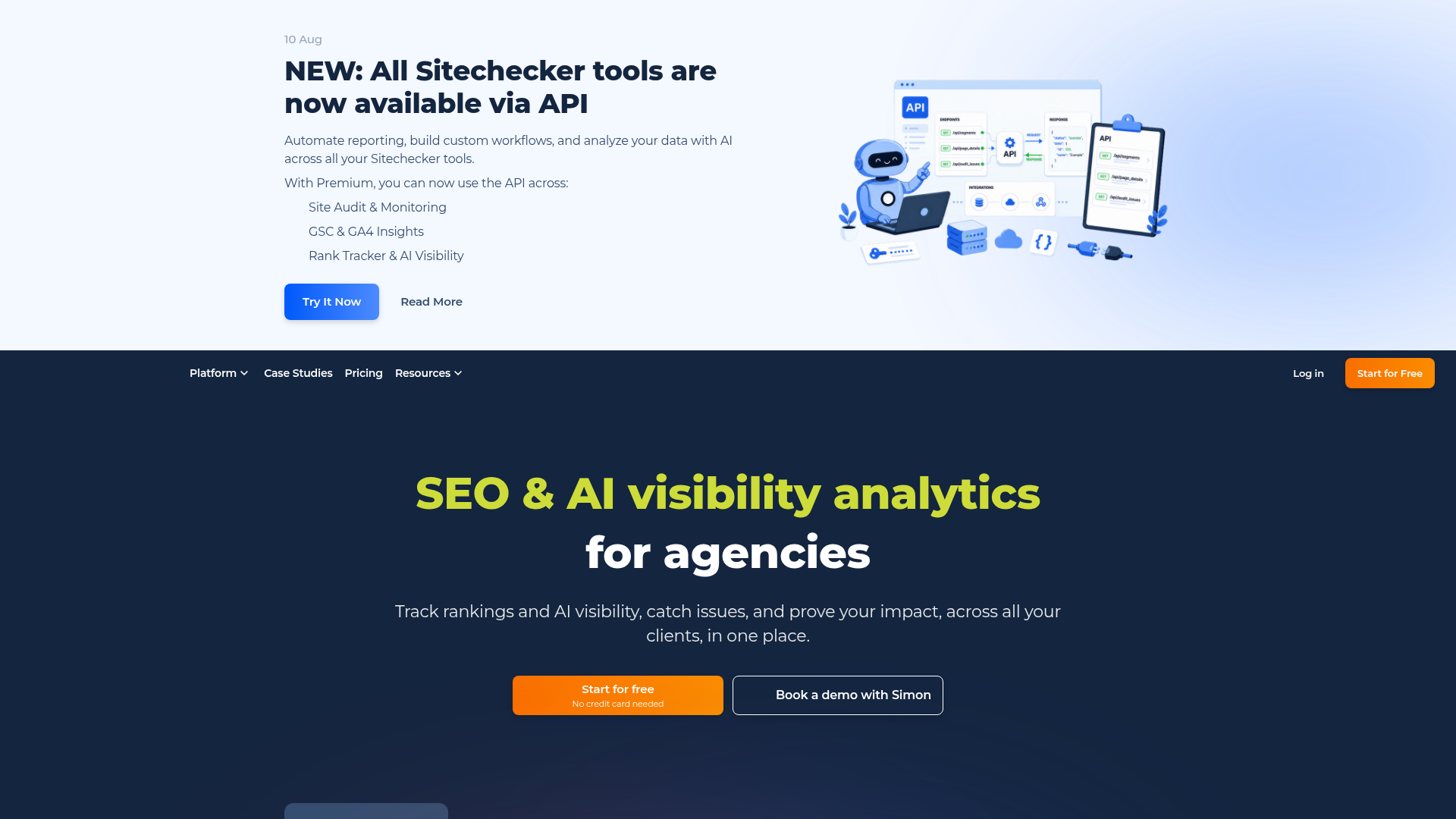
Sitechecker is a strong choice for agencies that rely heavily on technical SEO. It is best known for site auditing, website monitoring, rank tracking, backlink tracking, and reporting features built around agency workflows. White-label capabilities are also included, which is especially useful for firms that need to present technical SEO work under their own brand for clients. Across multiple websites, Sitechecker gives teams clear visibility into performance and issues. Its range is narrower on the content side, though, since the platform stays focused on technical performance rather than AI-driven content production.
Core Features
- Technical SEO auditing
- Website monitoring, alerts, and rank tracking
- Backlink tracking
- Agency dashboards
- Branded reports and notifications
- White-label platform options
Pros
- Strong technical audits: Sitechecker helps teams find crawl, indexation, and on-site issues across a large number of properties.
- Multi-site visibility: Agencies managing several client websites can monitor performance from one system, which is a practical advantage at scale.
- Agency-oriented options: Branded dashboards and notifications make it a better fit for client work than many tools that focus only on audits.
- Accessible pricing ladder: Its tiered pricing gives smaller teams a lower starting point than some competitors aimed more directly at enterprise buyers.
Cons
- More audit-focused than content-focused: Teams looking for an AI content engine will probably need to pair it with other tools.
- White-label depth may vary by plan: Some advanced agency features may require a higher-tier plan or a custom setup.
- Less complete as a single resource: Agencies that want one platform covering ideation through publishing may find gaps they need to handle elsewhere.
Who It’s For
Sitechecker fits agencies and consultants that need strong technical SEO oversight, recurring site monitoring, and reporting that is ready to share with clients. It works particularly well for firms that already have their own content system but need better auditing and issue detection across several websites. The fit is especially clear where technical site health plays a major role in retention and reporting, since the work can be shown clearly to clients.
Unique Value Proposition
Sitechecker’s main advantage is the clarity it brings to technical SEO work. Rather than trying to cover every part of SEO, it focuses on practical visibility into website health and optimization issues. That makes it useful for agencies that want a dependable technical resource and a way to turn findings into branded client communications without adding extra complexity to their stack.
Pricing: Standard $49/month, Premium $149/month, Enterprise $399/month
Website: https://sitechecker.pro
4. Search Atlas
At a Glance
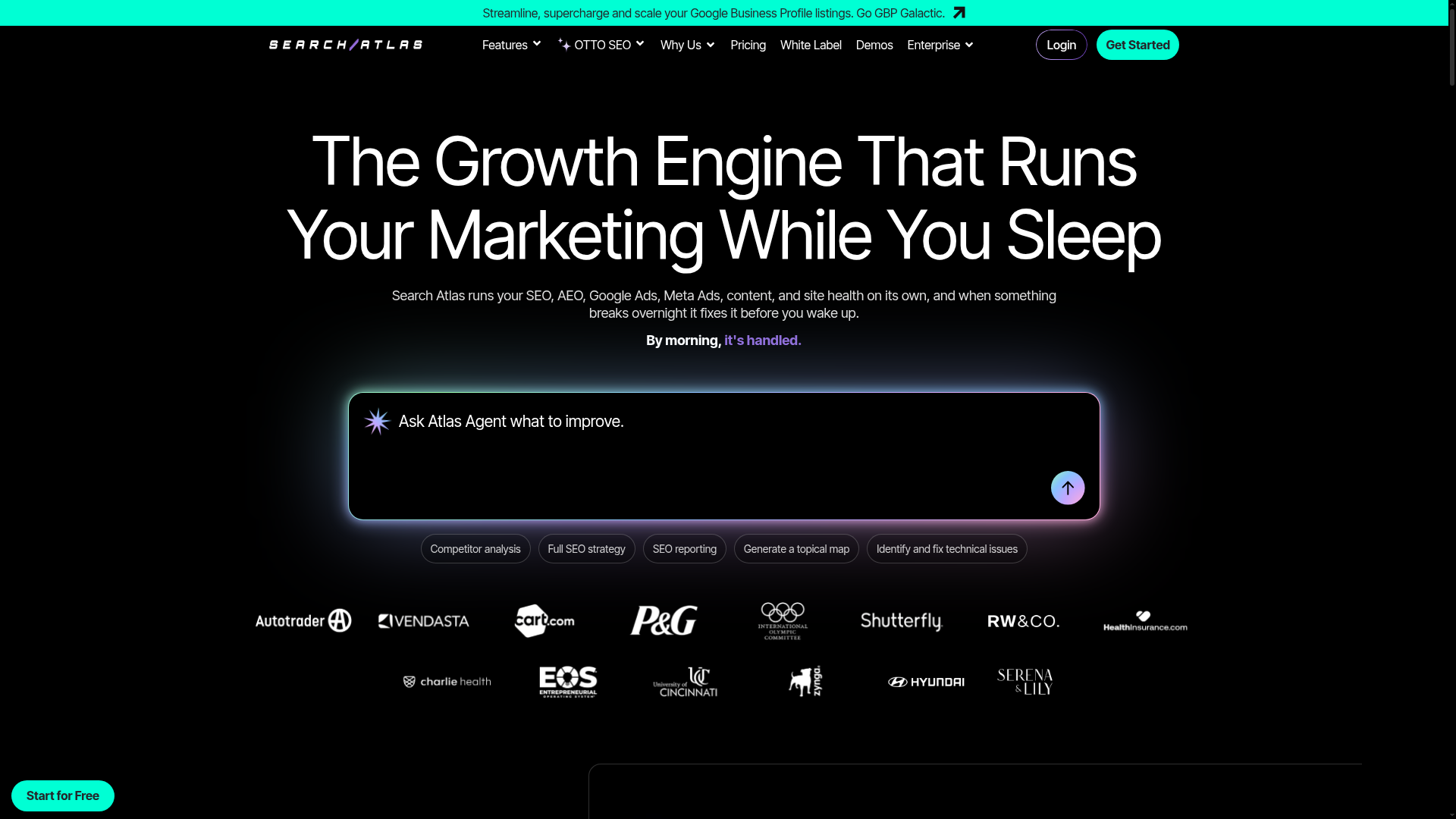
Search Atlas presents itself as a newer, AI-focused all-in-one SEO platform. It brings together content optimization, site audits, backlink tools, keyword research, local SEO, white-label software, and automation features including OTTO. For agencies trying to combine several workflows in one place, that range can be appealing and practical. It also stands out as a relevant option for teams that want AI-assisted SEO work to play a bigger role in day-to-day operations. At the same time, some buyers still see it as newer from a market-perception standpoint than more established agency platforms. Its advanced automation features also require careful internal process control as part of the tradeoff.
Core Features
- Content optimization tools
- Site auditing and technical SEO support
- Backlink tools
- Keyword research
- Local SEO capabilities
- White-label software and branded environments
- AI automation features including OTTO
Pros
- Broad all-in-one scope: It covers content, technical SEO, local SEO, and reporting within a single platform.
- AI-focused positioning: Search Atlas suits agencies that want automation to play a bigger role in daily operations.
- White-label support: Agencies can deliver services under their own branding.
- Can grow with client portfolios: The platform is designed for teams managing multiple campaigns and accounts.
Cons
- Automation requires oversight: AI-led workflows still need process controls and review standards.
- Newer platform perception: Some buyers prefer vendors with longer and more established track records.
- Breadth can create complexity: Teams may need time to fully put the available feature set in place.
Who It’s For
Search Atlas fits agencies looking for an all-in-one platform with stronger AI positioning than many older SEO suites. It works especially well for teams that want to bring content optimization, audits, and white-label delivery together in one environment. They also need to be comfortable building process discipline around automation, because that requirement is not minor. Agencies that expect automation to run without oversight may find the platform less comfortable to manage.
Unique Value Proposition
Its main appeal is the combination of broad platform coverage and AI capabilities. Search Atlas is built to reduce the need for separate subscriptions by bringing content and SEO tools together with white-label functionality. For agencies supporting multiple service lines from one system, that can be a strong benefit. Broader platforms, however, usually need more setup and more intentional governance to produce the best results.
Teams comparing automation-heavy seo technology can also review SEO Automation Platform: Top 5 Agency Tools for additional context around operational workflows and AI support.
Pricing: Starts around $99/month
Website: https://searchatlas.com
How to choose the right SEO technology resource
The right choice depends less on feature count than on the bottleneck inside the business. If an agency is running into issues with content output, slow approvals, inconsistent client brand voice, or awkward publishing workflows, the priority should be a platform built to handle production at scale. That is the most useful filter.
If the bigger problem is technical monitoring or client reporting, a system focused on audits or dashboards may be enough. For agencies that are growing, though, SEO technology usually needs to solve several operational problems at the same time.
In practice, growing agencies tend to need five things from SEO technology:
- A way to produce more content without adding labor at the same rate
- Brand controls that keep AI output from sounding generic
- Technical SEO support so content is not published in isolation
- White-label presentation that strengthens agency credibility and retention
- Integrations that reduce friction during handoffs between systems
That is the lens for this comparison. The category is crowded with platforms for tracking, auditing, and improvement, but fewer tools work as a real resource for scaling content operations from brief to publish-ready output while still fitting the way agencies deliver work. It is a narrower field, and that is why Whitelabelseo takes the top spot here.
Where each platform fits best
Agencies do not all need the same stack. A content-heavy SEO shop working with SaaS brands has very different day-to-day needs from a consultant focused on local rankings and monthly reporting; they are not solving the same problem. The shortlist makes more sense when you look at it that way.
- Whitelabelseo: Best for agencies that need AI content production that can grow, white-label delivery, and brand voice control
- WebCEO: Best for agencies that want mature reporting, portals, plus established white-label infrastructure
- Sitechecker: Best for technical SEO-first teams that need monitoring, audits, and branded deliverables
- Search Atlas: Best for agencies looking for a broad all-in-one platform with stronger AI and automation focus
For teams whose growth depends heavily on content output, the choice of technology matters more because it cuts production drag. Many teams make an expensive mistake here: they buy a tracking suite, then later find they still need separate systems for briefs, AI content, voice alignment, review, CMS workflows, and client branding. In a scaling agency, that gap tends to show up quickly.
SEO technology workflow gaps agencies notice later
One common issue is fragmentation between strategy and execution. A reporting suite may handle rankings and audits effectively, but the team still spends hours moving drafts between separate systems or manually revising AI output to fit client voice standards.
Another challenge appears during onboarding. Agencies often standardize reporting before they standardize production, which creates inconsistent delivery methods between accounts. Resources like SEO Onboarding Docs Every Agency Should Standardize become useful when agencies start scaling multiple client workflows at the same time.
What agencies overlook before buying
Software evaluations often focus on visible features while missing the operational details that decide whether a platform becomes truly useful or just ends up as shelfware. Before committing to any seo technology, these questions are worth asking early:
- Can the platform support multiple brand voices without constant manual cleanup?
- Does it fit your existing CMS and publishing workflow?
- Is white-label functionality cosmetic, or does it actually support client delivery?
- Will your team need additional tools for technical SEO, approvals, or content QA?
- How easily can account managers, strategists, and writers work within the same workflow?
Teams often underestimate these points. Scaling content is not just a writing challenge; it is also an operations issue. The best resource helps the team move from strategy to execution in a consistent way, without adding hidden work across the process.
Evaluating long-term SEO technology fit
A platform may look efficient during a demo while still creating operational friction later. Teams should evaluate how quickly writers, strategists, editors, and account managers can collaborate inside the same environment without adding duplicate steps.
It also helps to review how flexible the platform remains as service offerings expand. Agencies adding local SEO, e-commerce support, or national campaigns usually need systems that can adapt without forcing a complete workflow rebuild.
Ready to scale content without adding chaos?
If a team is stuck between rising content demand and limited delivery capacity, the issue usually isn’t effort. It’s the way the workflow is built. Many agencies still piece together separate tools for writing, improvement, reporting, and publishing, then watch margins shrink as output increases and the stack becomes harder to manage.
The right seo technology should reduce that friction rather than add another system to manage. Whitelabelseo stands out because it’s built around what agencies and brands actually need to scale AI-driven SEO content while keeping delivery polished, consistent, and white-labeled.
Instead of making teams trade speed for control, it supports both through content automation, technical SEO support, custom brand voice settings, and CMS-friendly workflows, the practical features that tend to matter in day-to-day production. If the next growth resource is under review, this is a good place to start.
If that’s the current stage, visit Whitelabelseo.ai to see how the platform can help an agency publish more efficiently, serve more clients, and build an SEO operation that can grow.
Frequently Asked Questions
Start with workflow fit, not hype. The best platform should support content creation, optimization, approvals, publishing, and reporting in a way that matches how your team actually works. White-label capabilities, brand voice control, CMS integrations, and technical SEO support are especially important for agencies that need to deliver at scale without sacrificing consistency.
Look at production metrics before and after adoption. Useful benchmarks include draft turnaround time, number of content pieces published per month, revision frequency, time spent on manual optimization, and how quickly assets move into the CMS. A platform like Whitelabelseo is particularly relevant if your bottleneck is content throughput combined with white-label client delivery.
Pricing varies widely depending on whether the platform is mainly a reporting tool, a technical audit system, or a broader AI content and SEO operations platform. In this comparison, public entry points range from about $49/month to around $99/month and above. Enterprise needs, white-label customization, and larger usage limits can increase total cost.
Operational results can show up quickly, often within the first few weeks, especially if the tool reduces bottlenecks in drafting, optimization, or reporting. Search performance improvements typically take longer and depend on content quality, site authority, competition, and implementation quality. Think in two timelines: immediate workflow gains and medium-term SEO gains.
SEO agencies, digital marketing firms, freelancers serving multiple clients, SaaS teams with lean marketing departments, and e-commerce brands managing ongoing content demand all benefit. Businesses that need scalable output plus client-facing polish gain the most from white-label systems because they improve both efficiency and presentation.
Not always. If your biggest pain point is purely technical monitoring, a specialized tool may be enough. But if you need to scale content, maintain brand consistency, support SEO execution, and keep delivery white-labeled, an all-in-one or more operationally integrated option can offer better long-term value. Whitelabelseo is a good example of a platform that aligns well when content scale is the priority, not just reporting or audits.