Local SEO Tools for Agencies Managing Many Locations

Choosing Local SEO Software That Can Actually Handle Scale
When local SEO is for one business, most solid platforms can usually handle the work. Once an agency is managing dozens or hundreds of locations across several clients, though, it becomes a very different situation, and that change tends to show up fast. Priorities shift quickly. Bulk updates matter more, reporting needs to move faster, Google Business Profile workflows become more central, review monitoring needs more attention, and the team needs local ranking data it can actually trust without losing half the week to cleanup. Choosing the right local SEO tools early can prevent many of those operational problems from growing.
That’s what makes choosing the right local SEO software such an important decision for agencies. This review examines four strong options for teams managing large numbers of locations at the same time: BrightLocal, Semrush Local, Yext, and Uberall. All four cover core local SEO software needs, but they solve different agency problems. Some make more sense for reporting-heavy workflows, especially when white-label delivery is important. Others are often a better fit for enterprise governance, listings control, and closer oversight, which in many cases matters more as an agency grows. Different strengths, different use cases.
If an agency is trying to scale local ranking work without adding even more operational chaos, this comparison should save time. Rather than chasing features just to complete a checklist, the focus stays on which platform fits a specific agency workflow best. The goal is simpler: help teams find the right match faster.
What You’ll Find in This Comparison
- BrightLocal
- Semrush Local
- Yext
- Uberall
Four Local SEO Platforms to Consider
BrightLocal
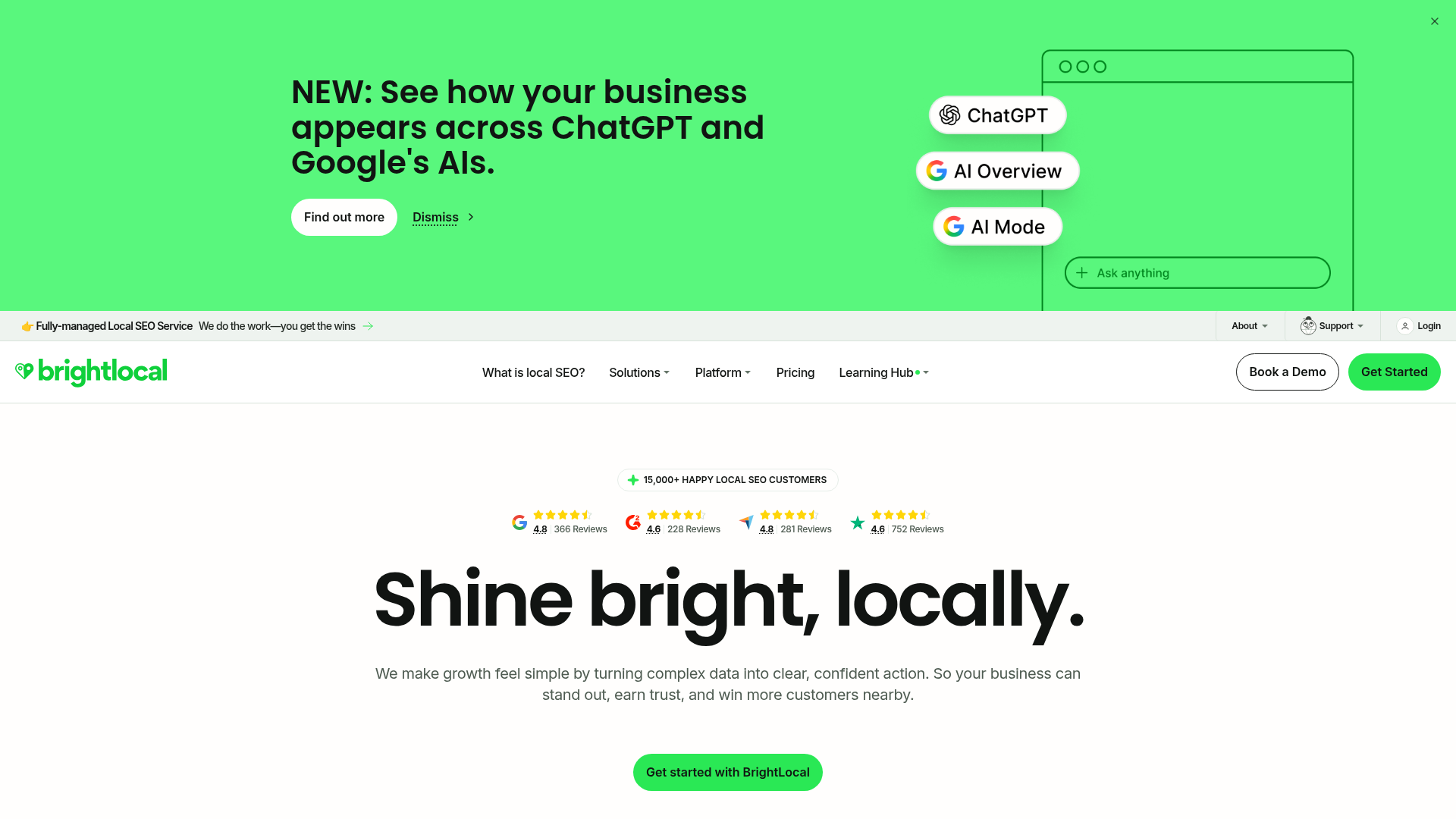
At a Glance
BrightLocal is one of the more straightforward options for agencies that need practical, repeatable local SEO workflows across many client locations. Founded in 2009, it has built a solid reputation for local rank tracking, citation management, reviews, audits, white-label reporting, and bulk management. That mix matters because agencies usually don’t need just one isolated feature. In most cases, they need a system that supports delivery, reporting, and account management without feeling like an enterprise platform built mainly for one huge brand, which can become awkward fast. BrightLocal handles that well, especially for agencies trying to scale without making daily use more complicated than it needs to be.
Core Features
- Local rank tracking for maps and local search results
- Google Business Profile management workflows
- Citation tracking and citation building tools
- Review monitoring and reputation management
- Local SEO audits for location-level issues
- White-label reports and client dashboards
- Bulk management for multi-location campaigns
Pros
- Agency-friendly workflows: The platform feels built for service delivery rather than internal brand operations, and that difference is easy to notice.
- Strong white-label reporting: Useful when clients expect polished updates without creating a lot of manual work.
- Balanced local toolkit: It brings rankings, citations, reviews, and audits into one platform, which is often what agencies actually need.
- Good fit for multi-client setups: It is easier for agencies to use than tools built mainly for a large enterprise brand.
- Established reputation: BrightLocal has focused on local SEO for a long time, and that usually shows in how the product is organized.
Cons
- Per-location costs can add up: What seems affordable at a smaller scale may feel less affordable once the number of locations gets very high.
- Less enterprise-heavy than some rivals: Brands with especially complex governance requirements will often lean toward other options.
- Some advanced automation is lighter: Agencies with highly customized internal workflows may still need additional systems, or at least extra process layers.
Who It’s For
BrightLocal is best suited to agencies and consultants managing many local clients who want dependable execution without paying for an oversized enterprise platform. It is especially useful for teams that need local ranking visibility, listing and citation support, review monitoring, and client-ready reporting while keeping the setup focused on local SEO work. If that describes the work being done, it is a very strong fit.
Why BrightLocal Often Fits Agency Delivery
Many agencies evaluating local SEO tools eventually realize that delivery efficiency matters just as much as raw feature depth. BrightLocal tends to work well because the workflows are relatively easy to repeat across many clients without creating unnecessary complexity. That can matter a lot when account managers and SEO specialists are sharing responsibilities across several campaigns at once.
Unique Value Proposition
BrightLocal stands out because it fits real agency operations well. It supports the day-to-day work of delivering local SEO services for multiple brands instead of pushing teams toward enterprise governance logic. The white-label approach also makes it easier to present results clearly in client dashboards and reports, which saves time in a very practical way. For agencies trying to protect margins and reduce account management time, that often becomes a meaningful advantage.
Pricing: Public plans are listed from $39, $49, and $59 per month when billed annually on BrightLocal’s pricing page.
Website: https://www.brightlocal.com/
Semrush Local
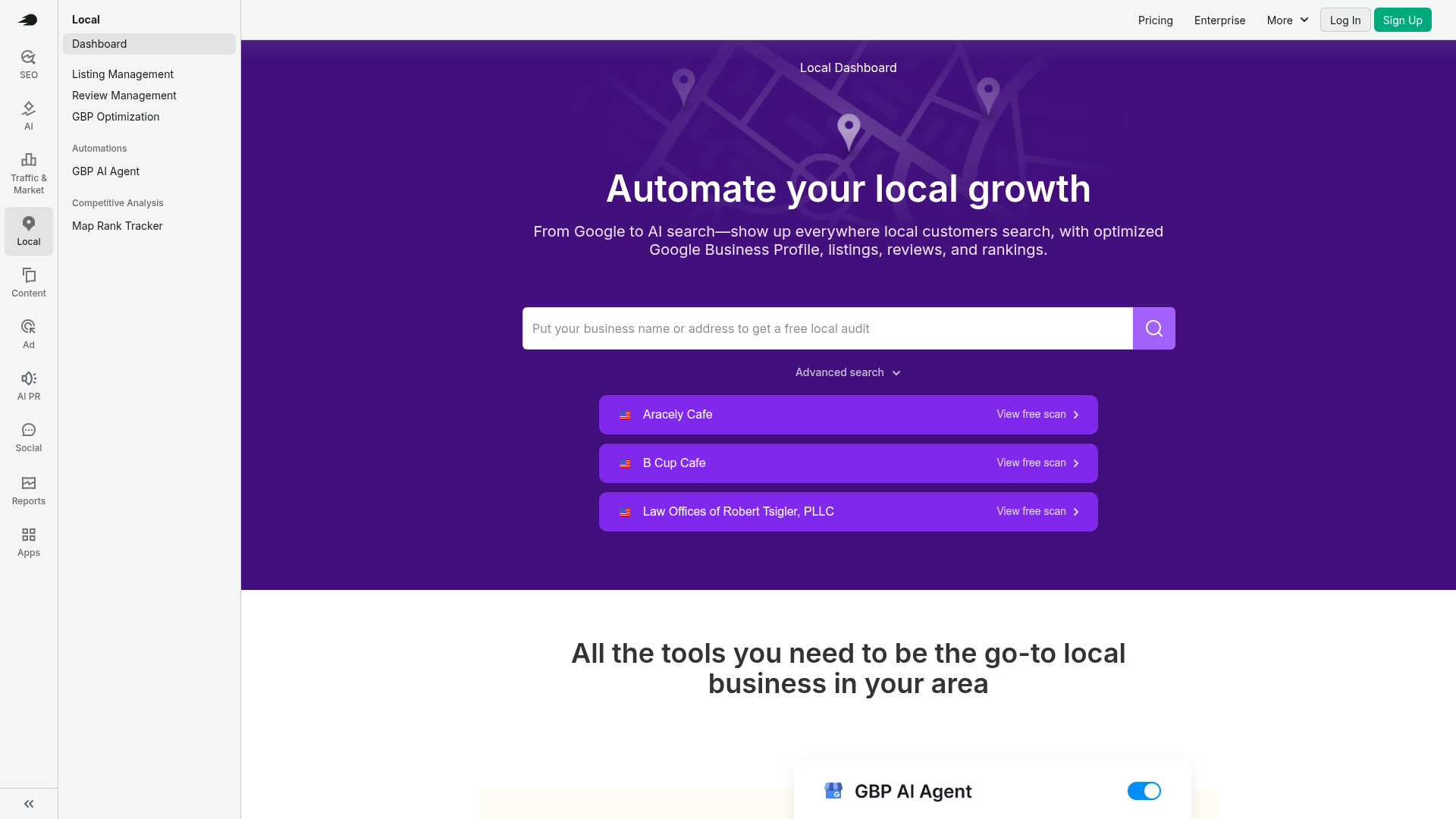
At a Glance
Semrush Local is a solid option for agencies that already work inside the broader Semrush ecosystem. Since launching in 2008, Semrush has built its reputation as a full SEO platform, and its local tools are usually most useful when local visibility management needs to connect directly with national SEO, keyword research, reporting, competitive analysis, and related campaign work. Everything sits in one place, which is often the biggest advantage. It is not the most white-label-focused local platform for agencies, but it is convenient for teams that would rather keep everything in a single software stack than bring in a separate local SEO tool.
Core Features
- Listing management across major directories
- Local rank tracking and map visibility monitoring
- Review monitoring and Google Business Profile support
- Local visibility reporting
- Integration with broader Semrush campaigns, reporting, and wider SEO keyword workflows
Pros
- Convenient ecosystem fit: A practical choice for agencies already using Semrush every day.
- Broader SEO context: Useful when local campaigns need to connect with content, backlinks, technical SEO, or larger search efforts.
- Familiar interface: Existing users can usually get comfortable faster because they already know the platform, so there is less ramp-up.
- Reduced tool sprawl: Keeps local and non-local SEO work closer together.
Cons
- Less white-label focused: Agencies that put more emphasis on branded client reporting will probably prefer BrightLocal.
- Add-on pricing model: Costs can increase as an extra layer on top of an existing Semrush subscription.
- Not as specialized: Teams that want a dedicated local SEO workflow may find it less tailored to that specific use case.
Who It’s For
Semrush Local works best for agencies that already rely on Semrush for broader SEO and want local rankings, listings, and visibility management in the same system. It is especially useful when local SEO sits inside a larger search strategy instead of operating as a separate service line with its own delivery model. Setup is straightforward, and the use case is easy to understand, which is often a meaningful factor when choosing tools.
For teams comparing broader agency SEO software, this type of all-in-one workflow can simplify onboarding and campaign management.
Unique Value Proposition
Its main advantage is consolidation. For teams already using Semrush for keyword research, reporting, and site analysis, adding local functionality can make training and workflow management easier. In many cases, it also removes the need to patch together several platforms, because local search support stays inside a stack the team already knows. That approach seems especially well suited to agencies that care more about operational simplicity than highly specialized local features.
Pricing: Semrush Local is commonly listed at about $30 per month as an add-on in third-party roundup research. Overall platform pricing, however, varies by Semrush plan.
Website: https://www.semrush.com/local/
Yext
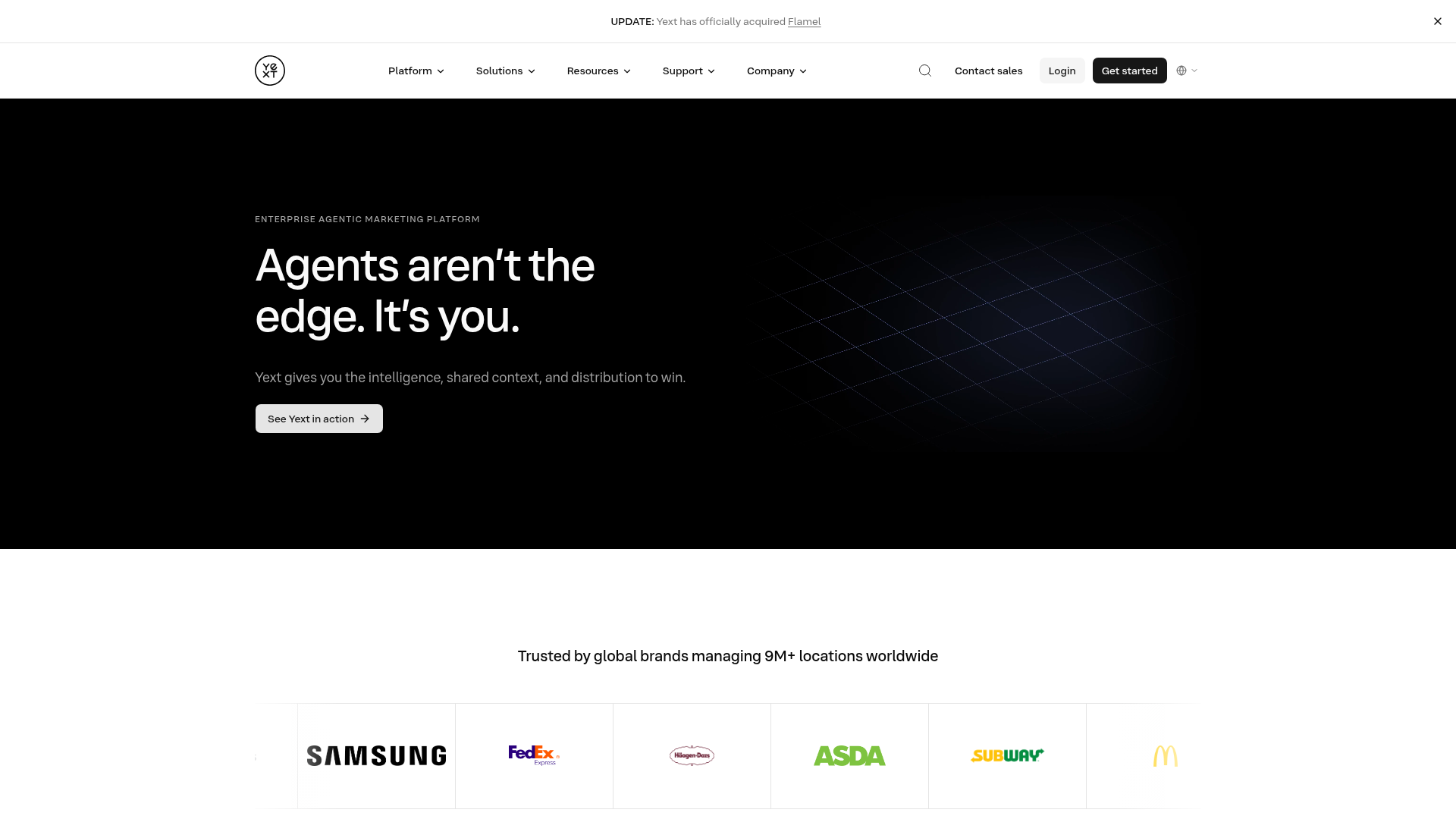
At a Glance
Yext, founded in 2006, remains one of the best-known names in listings management and location data control. It is especially useful for businesses that need very tight consistency across a broad publisher network and want centralized oversight of location information. For agencies, Yext can be a strong option, although it usually makes the most sense for large multi-location brands, franchise systems, or enterprise organizations rather than every type of client setup. It is not always the simplest fit. Even so, when the main challenge is keeping location data accurate across a large footprint that spans directories, maps, and publisher sites, it is often one of the more capable platforms available.
Core Features
- Listings distribution across a large network
- Centralized location data management
- Review management
- Publisher network synchronization
- Performance analytics and monitoring
- Enterprise governance for multi-location brands
- Brand consistency controls across locations
Pros
- Strong listings control: Very effective for maintaining consistent location data across many publishers.
- Enterprise-grade governance: Helpful for chains, franchises, and more complex brand structures.
- Recognizable platform: Many larger brands already know Yext or include it in platform evaluations.
- Scales well for single-brand portfolios: Especially useful when one organization manages a large number of locations.
Cons
- Opaque pricing: It can be harder to evaluate quickly than tools with simpler public pricing.
- Less naturally agency-centric: It tends to fit big brands better. Agencies managing many smaller client accounts may find it less intuitive, especially if they are used to lighter tools.
- Can be expensive: The cost is often harder to justify for budget-conscious local SEO programs.
Who It’s For
Yext is best suited to agencies serving enterprise clients, large chains, and franchise systems where location data governance matters at least as much as rankings. When a typical client has strict brand controls, needs to sync a large set of directories, and has internal stakeholders who care deeply about consistency, Yext deserves serious consideration. It is a strong fit in that setting, particularly when there are many locations and multiple approval layers to manage.
Where Enterprise Governance Changes the Decision
Some local SEO tools are built mainly around campaign execution, while others prioritize governance and data consistency. Yext leans heavily toward centralized control, which is usually why larger enterprise organizations continue evaluating it even when there are lower-cost alternatives available.
Unique Value Proposition
Yext’s core strength is control. It is built to keep business information synchronized across a broad network at scale. That becomes especially valuable when mistakes in hours, addresses, or brand details create real operational risk, such as customers arriving at the wrong address or seeing inaccurate opening times, which happens more often than brands expect. For agencies supporting enterprise local SEO, that level of control can matter more than choosing the cheapest or simplest platform. That is usually the real appeal: consistency, oversight, and fewer data issues across a large set of locations.
Website: https://www.yext.com/
Uberall
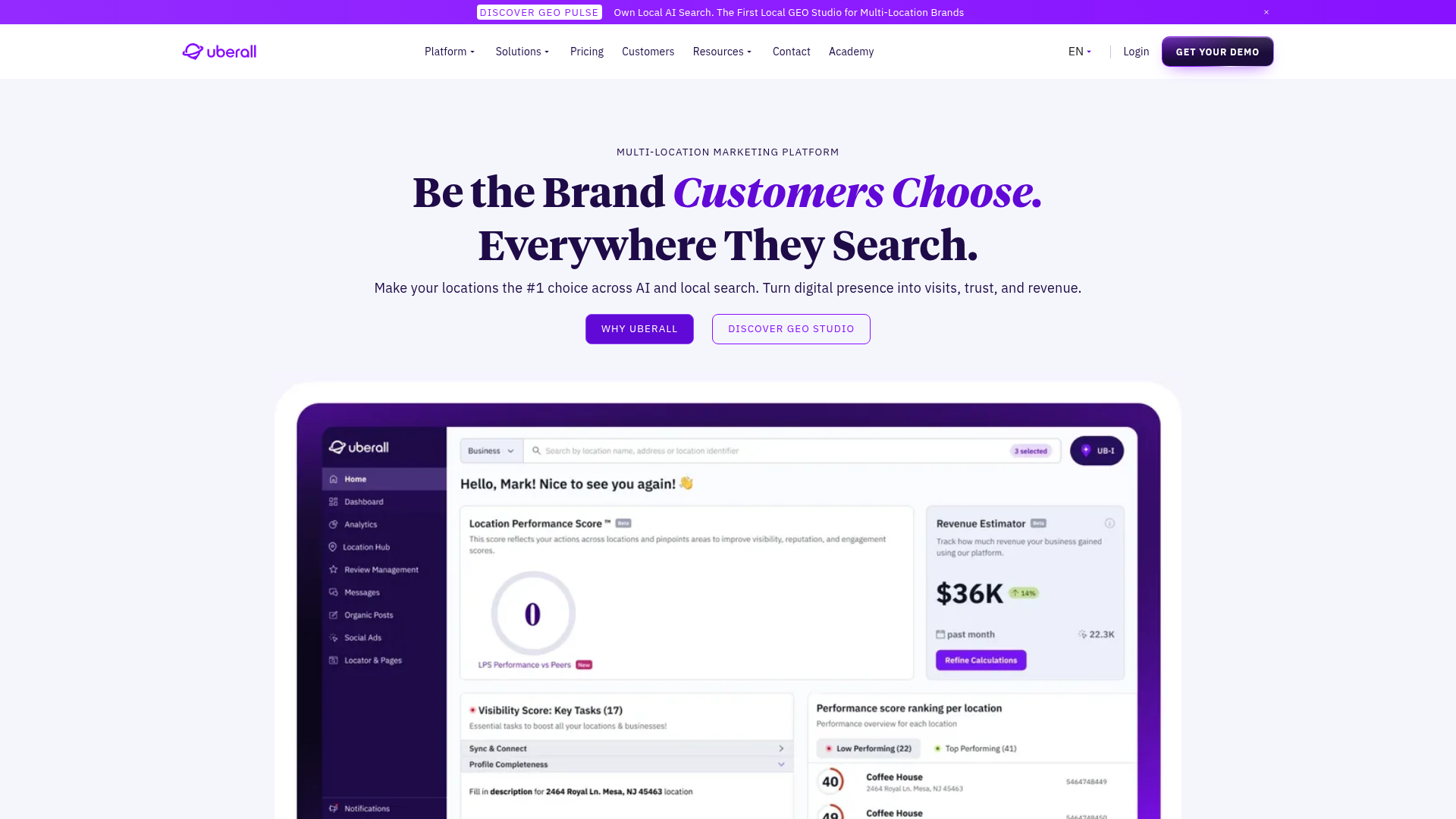
At a Glance
Uberall, founded in 2013, is built for large multi-location businesses that need to manage listings, reviews, and local presence from one central dashboard. It is usually positioned for brands and marketing teams with broad location footprints, and agencies serving franchise-style clients or regional chains will likely find it useful too. The main draw is scale, along with clear central oversight, which is often the main reason teams choose it. Uberall isn’t especially focused on lightweight local SEO work for smaller accounts. Instead, it is designed to keep a large local presence organized, visible, and consistent across many locations at the same time.
Core Features
- Listings management across directories
- Review management and monitoring
- Centralized multi-location dashboards
- Performance analytics
- Bulk updates across many locations
- Local marketing and visibility tools
- Oversight for large location portfolios
Pros
- Strong scalability: Designed for organizations managing a high number of locations.
- Centralized control: Useful when one team needs oversight across multiple branches, markets, or regional groups.
- Useful for franchise and chain models: Often a good fit for businesses with repeatable location structures.
- Solid review and listings management: Covers the main operational essentials well, and that is often what teams need most.
Cons
- Pricing isn’t transparent: That makes upfront comparisons harder than with tools that publish pricing publicly.
- Enterprise-oriented feel: Smaller agencies may find it heavier than necessary for routine work.
- Potential overkill: If clients only have a limited number of locations, some of that complexity may go unused.
Who It’s For
Uberall is best suited to agencies serving large brands, franchise groups, and multi-location businesses that need centralized local presence management more than deeply customized agency reporting. It tends to make the most sense when scale and governance matter most, especially when a central team needs control across regions or brand locations. In practice, that is often the deciding factor. The use case is fairly clear.
Teams researching SEO automation software for white-label agencies often look at platforms like Uberall when operational scale becomes harder to manage manually.
Unique Value Proposition
Uberall stands out for centralized oversight across very large local footprints. For client bases that include brands coordinating listings, reviews, and updates across many locations at once, it can reduce operational friction. Its value is fairly direct: it helps teams make bulk changes, monitor reviews, and keep location data consistent without moving between multiple systems. It is less focused on being the most flexible specialist tool. Instead, it is usually most useful when local presence management becomes more complex and teams need a simpler way to keep that work under control.
Website: https://uberall.com/
How the Pricing and Founding Dates Compare
Across these tools, the clearest comparison usually focuses on pricing transparency and company maturity, which most buyers tend to check first. BrightLocal publishes clear plan pricing, so costs are visible on its pricing pages. Semrush Local, by contrast, is often sold as an add-on. Yext and Uberall are much less transparent for buyers trying to assess costs at scale, especially across larger numbers of locations.
| Company | Founded | Public Starting Price | Pricing Model | Official Website |
|---|---|---|---|---|
| BrightLocal | 2009 | $39/month | Public plans | brightlocal.com |
| Semrush Local | 2008 | $30/month add-on | Add-on to broader platform | semrush.com/local |
| Yext | 2006 | $199/year per location estimate | Quote-heavy / enterprise | yext.com |
| Uberall | 2013 | , | Quote-based | uberall.com |
For agencies that need predictable budgeting, BrightLocal is probably the easiest option to estimate. Yext and Uberall, however, often make more sense for enterprise clients, particularly when procurement is already involved and approvals typically move through formal buying cycles.
What Matters Most for Local Ranking at Agency Scale
Choosing local SEO software isn’t really about whether a platform can track rankings. Honestly, most tools can do that. The difference usually becomes clear when harder, more practical questions come up in daily work:
- Can your team manage dozens of Google Business Profiles without creating messy handoffs?
- Can reviews be monitored, then answered or escalated quickly when needed?
- Can account managers send polished updates without needing to export data across several other tools?
- Can workflows be separated for franchises, regional groups, and independent multi-location clients?
- Can the platform support execution as well as client communication?
This is often where agencies make the wrong purchase, and here it can be a costly mistake. They buy based on headline features, then realize the platform was built for a different operating model, which happens more often than many expect. If the client roster leans heavily toward franchises, Yext or Uberall will usually make more sense. But for a service-heavy agency working across many separate brands, BrightLocal is often the better fit. And if the broader SEO retainer model already runs on one software stack, Semrush Local is often the most practical option.
Agencies comparing best SEO software for content-led growth teams also tend to evaluate how well local SEO tools integrate with broader reporting and campaign workflows.
Agency Scenario for Best Fit
If you run local SEO as a productized agency service
BrightLocal is usually the best fit. It often works well for repeatable delivery, especially for agencies, and is also useful for white-label reporting and managing multiple client accounts.
If your team already works inside one larger SEO platform
Semrush Local will probably make the most sense. It may not be the most specialized local tool, but convenience often matters here. That is especially true when the main priority is adoption or keeping the team’s processes consistent.
If your clients are enterprise chains or franchise systems
Yext’s a strong option here, especially so. For enterprise chains or franchise systems, location data governance often matters more than lightweight campaign flexibility.
If your clients operate large location footprints
Uberall is probably worth strong consideration, especially when centralized visibility and operational control across many locations matter in daily work. It focuses less on polished, agency-style presentation layers.
So Which One Should You Pick?
For agencies managing a large number of separate client locations, BrightLocal is probably the best all-around pick. It combines dedicated local SEO tools with workflows and reporting that fit agency work, making it easier to handle listings, audits, and client updates in one place, which is a real advantage in day-to-day use. A practical fit for busy teams.
If an agency already uses Semrush and wants local SEO software within a broader marketing stack, Semrush Local is often the better option. Yext is the premium choice for enterprise-level listings control, especially for large brands and franchise systems, where consistency across locations often matters a lot. Built to scale.
Uberall, meanwhile, usually makes the most sense for very large multi-location operations that need centralized oversight more than lighter service delivery. So the right choice usually depends on how the agency works, which tools are already in place, and how much centralized control is really needed.
Turning the Right Tool Into a Repeatable Agency System
The platform itself is only one part of the decision. The bigger advantage, I think, usually comes from turning that tool into a repeatable system for onboarding, local ranking reviews, Google Business Profile optimization, review workflows, and client reporting. That’s where many agencies tend to get stuck, and it happens often. They buy software, but never build the operating process around it.
Whether the choice is BrightLocal, Semrush Local, Yext, or Uberall, it helps to look beyond the initial setup. Define who owns listings accuracy, and make it clear who is responsible for monitoring local rank changes in map packs and local search results. One useful step is setting a schedule for review triage, then clarifying what clients actually need to see in reports, such as ranking shifts, listing issues, and review trends. Small details usually matter more here than many teams expect. That kind of process discipline is what turns local SEO tools into agency systems that are easier to scale and often better for margins.
For agencies building repeatable multi-location workflows, this guide to multi-location SEO strategies for local search success offers additional operational context.
If you want help thinking through how modern SEO operations should work across content, technical SEO, reporting, and scalable delivery, Whitelabelseo.ai is a useful place to keep learning. The site focuses on how agencies can build cleaner, more scalable SEO workflows around the tools they choose. Related guidance is also covered in this AI-powered platform for white label SEO operations if you’re trying to connect local SEO execution with broader agency growth systems.
Frequently Asked Questions
Start with workflow fit, not feature count. Agencies managing many locations need bulk actions, reliable local rank tracking, listings management, review monitoring, and reporting that does not add extra admin work. Practical capabilities matter most. If local SEO is delivered under the agency’s own brand, white-label reporting matters a lot. A multi-client account structure matters too.
Expect stronger visibility in map packs and local organic results, more accurate listings, broader review coverage, and faster reporting cycles. For agencies, effectiveness also means better operational efficiency. That is a real advantage.
When the software helps a team manage more locations with fewer manual steps, that matters. Whitelabelseo.ai also regularly shares practical guidance on turning SEO tools into repeatable systems. This is useful when measuring results beyond rankings alone.
Pricing varies a lot. BrightLocal offers public plans starting at $39 per month, while Semrush Local is offered as an add-on at around $30 per month.
Enterprise-focused platforms such as Yext and Uberall are less transparent. They can require custom pricing based on the number of locations, features, and support needs.
The tool itself doesn’t deliver results overnight. Most agencies can quickly improve data accuracy, listing consistency, and reporting visibility. Ranking gains take longer and depend on the underlying strategy. Google Business Profile optimization also matters, along with reviews, on-page location signals, and competitive pressure.
Multi-location businesses benefit most from this, especially franchises, chains, service-area brands, healthcare groups, hospitality businesses, and the agencies that support them. A dedicated local SEO software platform becomes more useful as the number of locations, reviews, listings, and stakeholder approvals increases.
That depends on your operating model. The short answer is that specialist tools go further on listings, citations, reviews, and local workflows built for agencies.
All-in-one suites make sense when your team wants fewer platforms, especially if local search is only one part of a broader SEO service. It’s a different fit.
If you’re unsure which model fits your agency, Whitelabelseo.ai can help you work through the workflow side of the decision and choose based on delivery reality rather than feature marketing.