Best Content Automation Tools for SEO Agencies

If you’re comparing the best content automation tools right now, you’re probably under the same pressure most agencies face: publish more, keep quality high, protect brand voice and still make the margins work. The market for content automation tools and ai seo tools has matured quickly, but not every platform fits agency workflows, white label delivery or growth across multiple clients.
This comparison covers four well-known options SEO agencies and content teams regularly evaluate: a white-label-first platform, an enterprise SEO workflow tool, a content optimization suite and a publishing-focused AI writer. It’s not the flashiest software. The focus is on which solution actually helps agencies move faster without giving up control over quality, approvals, CMS publishing and the technical SEO basics that still matter.
For firms working with SaaS, e-commerce and local or national SEO clients, the right stack can decide whether growth stays profitable or content production becomes a constant bottleneck. A serious one. Below are the top tools worth considering, starting with the featured option that stands out most clearly for agencies that want automation with white label flexibility.
What You’ll Find in the Content Automation Tools Comparison
- Whitelabelseo
- Surfer SEO
- Clearscope
- Jasper
Top content automation tools to consider
1. Whitelabelseo
At a Glance
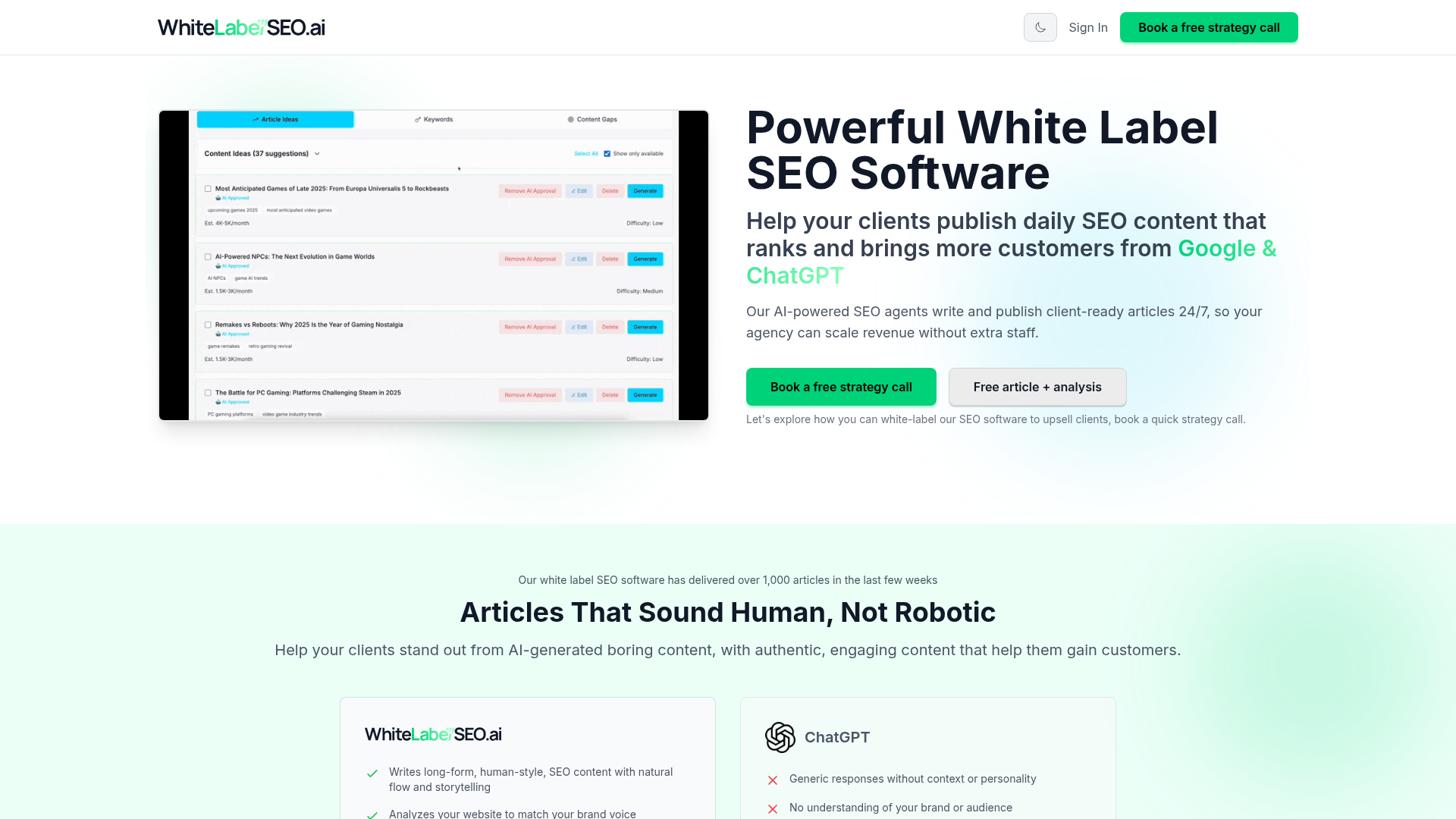
Whitelabelseo.ai helps agencies and marketing teams automate SEO content production without giving up control over brand voice, delivery quality, or client-facing workflows. It is not framed as a generic AI writer. Instead, it is presented as an AI-powered platform for scalable white label SEO execution that combines content creation, technical SEO support, CMS integrations, and brand customization in one place. That distinction matters, especially for agencies managing multiple accounts at the same time, where consistency and process control can matter as much as the writing itself. The platform is particularly useful for teams that want to standardize output, reduce manual content bottlenecks, and grow service capacity without building a large in-house production department.
Core Features
- AI-powered SEO content generation designed for scale
- White label delivery capabilities for agencies
- Brand voice customization across client accounts
- CMS integrations for easier publishing workflows
- Technical SEO optimization support
- Content automation for blogs and ongoing campaigns
- Multi-client workflow alignment for agency operations
Pros
- Built for agencies: The platform is clearly aimed at agency and reseller use cases, which makes it more practical for multi-client SEO delivery than many general AI writing tools.
- White label friendly: Teams that want client-ready outputs under their own brand rather than exposing third-party software will likely see this as a major advantage.
- Brand voice control: Customization matters when teams manage SaaS, e-commerce, and service clients with very different tones and messaging expectations.
- Workflow efficiency: CMS connectivity and automation features help reduce handoffs between strategy, writing, editing, and publishing, with less friction.
- Broader SEO fit: The platform does more than generate copy. It also supports the technical and operational SEO work agencies need to scale in a consistent way.
Who It’s For
Whitelabelseo is a strong fit for SEO agencies, digital marketing firms, SaaS growth teams, e-commerce brands, and consultants that want to scale AI-assisted content production while keeping client delivery polished and brand-safe. It is especially relevant for businesses that need white label fulfillment, repeatable onboarding, and more efficient publishing across multiple accounts or websites.
Unique Value Proposition
Whitelabelseo stands out by combining content automation with agency-focused infrastructure. Many ai seo tools help with writing or optimization. Fewer are built around white label service delivery, brand voice adaptation, and integrated execution across multiple client environments. That difference matters for teams that need more than a writing assistant. In those cases, this platform is likely the better fit. It works more like an operational layer for scalable SEO fulfillment, giving teams a way to create, optimize, and publish content that supports growth without turning every campaign into a custom production process.
Teams comparing broader agency SEO tools for content ops and client delivery will notice that the operational side of fulfillment often matters just as much as drafting speed.
Real World Use Case
A growing SEO agency managing ten SaaS and e-commerce clients could use Whitelabelseo to standardize blog production, adapt voice by account, and move content through connected CMS workflows. With that setup, the agency could increase output, maintain consistency, and keep delivery under its own branding instead of immediately hiring several additional writers and editors.
Website: https://whitelabelseo.ai/
2. Surfer SEO
At a Glance
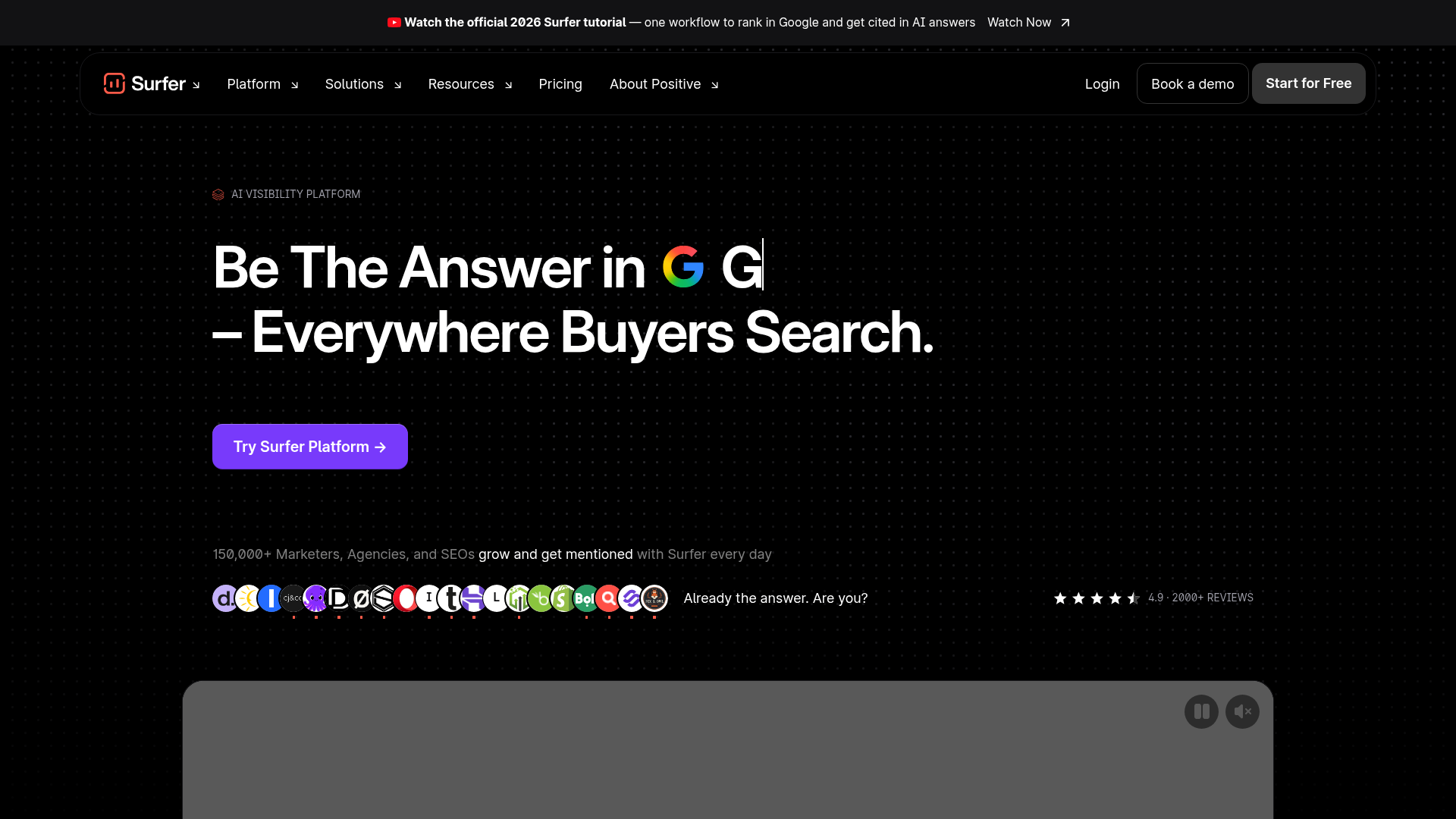
Surfer SEO is one of the best-known content optimization platforms in the SEO market. It combines SERP-based content analysis, AI-assisted writing support, content scoring, keyword guidance, and workflow tools so teams can build pages that match search intent and follow on-page SEO best practices. For agencies, one of the biggest advantages is the ability to set repeatable optimization standards across different writers and clients. Surfer is less focused on white-label use than agency fulfillment platforms, but it remains a popular option for teams that want strong on-page guidance and more structured content workflows.
Core Features
- Content Editor with real-time optimization scoring
- AI writing support through Surfer AI
- SERP and competitor-based keyword suggestions
- Content audits for existing pages
- Topical maps and planning features
- Integrations with Google Docs and WordPress
- Team collaboration and workflow support
Pros
- Strong optimization engine: Surfer is widely used because its content scoring and SERP analysis are straightforward to apply in day-to-day work. It’s easy to use.
- Good for standardization: Agencies can create more consistent briefs and editorial requirements across multiple accounts.
- Useful content audits: Existing pages can be updated with clearer optimization recommendations from the platform.
- Large market adoption: Because the platform is well known, training friction may be lower for teams that already have experience with it.
- Broad SEO utility: It supports planning, drafting, and optimization rather than focusing on only one stage of production.
Cons
- Less white label focused: Agencies looking for a client-invisible delivery layer may find Surfer less aligned with that model.
- Can feel prescriptive: Some writers feel boxed in by scoring systems when teams start replacing quality judgment with tool chasing. That’s a real risk.
- Pricing can add up: Costs can rise as content volume increases and more team members begin using the platform.
Who It’s For
Agencies, in-house content teams, and freelance strategists can use Surfer SEO to build a proven optimization workflow with keyword guidance and measurable content scoring. It works especially well for teams focused on improving editorial processes, updating older content, and scaling output through a consistent SEO system.
Unique Value Proposition
Surfer’s main strength is simple: it turns on-page SEO into a repeatable system. The platform gives writers and editors a shared structure for building content around competitive SERP signals, which helps reduce guesswork. For agencies that already have fulfillment capacity and need better optimization discipline, that structure can provide real value.
Teams researching how agencies evaluate AI SEO tools that scale often compare Surfer with more workflow-oriented systems before deciding which approach fits their delivery model.
Pricing: Essential from $99/month, Scale from $219/month, Enterprise custom pricing.
Website: https://surferseo.com/
3. Clearscope

At a Glance
Clearscope is a premium content optimization platform known for clean reporting, strong keyword relevance guidance, and solid editorial usability. In-house content marketers, publishers, and agencies choose it when they want high-quality optimization support without dealing with an overly complex interface. Its reports are especially useful for building content briefs and improving existing pages. It is not a white label automation platform in the same way agency-focused solutions are. Still, many teams value it because it helps them create more search-aligned content through a smooth editorial experience.
Core Features
- Content reports with keyword and topic recommendations
- Optimization grading for drafts and live content
- Content brief creation for writers
- Google Docs and WordPress integrations
- Competitive content analysis
- Content inventory and page optimization workflows
- Team collaboration support
Pros
- Editorially friendly: Writers frequently find Clearscope easier to use than more cluttered tools.
- High-quality reports: Its briefing and optimization recommendations are clear, practical, and useful.
- Good for refresh strategies: Agencies updating older content can get strong value from its reporting.
- Trusted by content teams: Serious editorial and SEO teams give it a strong reputation.
Cons
- Higher price point: Small agencies or freelancers may find it expensive.
- Less automation depth: It is more focused on optimization than end-to-end automated white label production.
- Limited all-in-one scope: Teams may still need separate tools for generation, workflow automation, and publishing.
Who It’s For
Agencies and content teams that care most about high-quality briefs, content refinement, and optimization for important landing pages or blog assets are the best fit for Clearscope. It is particularly useful for organizations with established writing processes that need better SEO direction rather than a full-service content automation engine.
Unique Value Proposition
Clearscope’s main advantage is clarity. The platform keeps teams focused on relevance and topical coverage without burying them in excessive metrics. For agencies managing premium clients or high-value content hubs, that simplicity is very useful because it supports stronger editorial collaboration and leads to cleaner optimization decisions.
Pricing: Essentials from $189/month, Business custom pricing.
Website: https://www.clearscope.io
4. Jasper
At a Glance
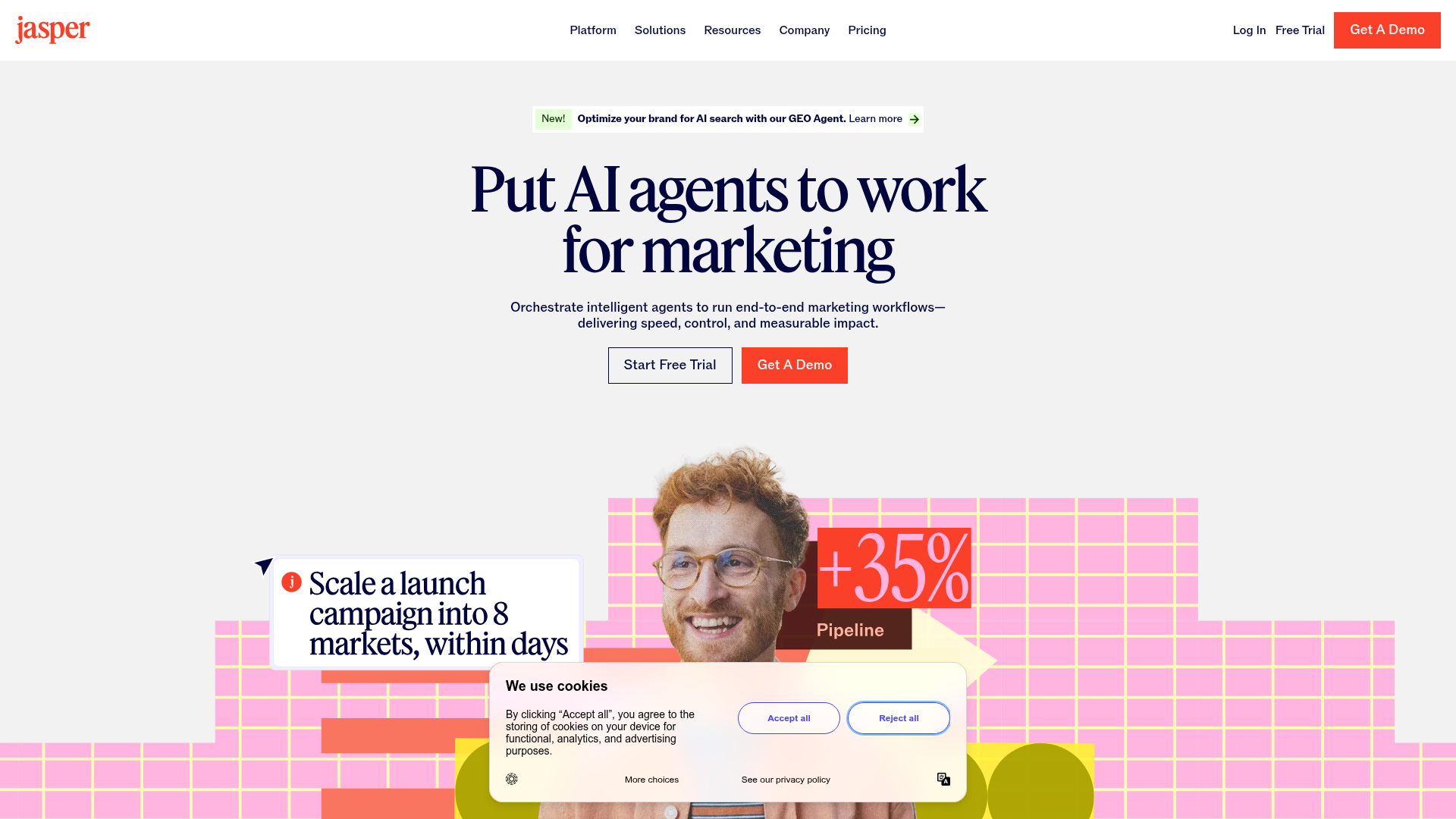
Marketers use Jasper for blogs, campaigns, product copy, emails and broader brand content production. It started as a straightforward AI writer and has grown into a wider marketing content platform with templates, workflows and brand voice controls built in. Its scope is intentionally broad. SEO agencies can use Jasper to speed up ideation and draft creation, especially when they pair it with other optimization tools already in their stack. On its own, Jasper is less specialized for SEO execution or white label service delivery than platforms built specifically for those use cases.
Core Features
- AI-assisted long-form and short-form content generation
- Brand voice and style guide support
- Campaign and workflow templates
- Collaboration tools for teams
- Browser extension and app-based writing workflows
- Integrations and API options on higher tiers
- Marketing-focused content assistance across formats
Pros
- Fast draft generation: Jasper helps teams move quickly from an idea to a first draft.
- Versatile use cases: It supports many content types, not just SEO blog articles.
- Brand features: Voice and style controls help multi-brand teams stay consistent, which is a practical benefit.
- Widely recognized: Many marketers already know the platform, which can make adoption easier across teams.
Cons
- Needs SEO pairing: Agencies generally need another platform for detailed optimization and SERP guidance.
- Generic output risk: Without strong prompts and careful review, drafts can feel broad, repetitive or too general.
- Not agency white label first: Jasper is more of a marketing AI platform than a white label SEO operations system.
Who It’s For
Jasper fits marketing teams, startups and agencies that want a flexible AI writing assistant across many channels instead of something focused only on SEO. It works best for teams that already have strategy and optimization processes in place and need faster production support across different content formats. It’s not a full SEO engine.
Unique Value Proposition
Jasper’s main strength is its range. It supports a wide variety of marketing content tasks, which makes it appealing for teams that want a single AI layer for campaigns, email, website copy and blog creation. For SEO agencies, Jasper generally makes the most sense as one part of a larger stack rather than a complete system on its own.
Pricing: Creator from $49/month, Pro from $69/month, Business custom pricing.
Website: https://www.jasper.ai/
How the Best Content Automation Tools Compare
If you’re trying to narrow the field quickly, start with the biggest dividing line: some tools help teams improve or draft content, while others help agencies manage larger-scale delivery. That difference matters more than feature lists.
| Company | Key Features | Pros | Cons | Pricing |
|---|---|---|---|---|
| Whitelabelseo | AI content generation, white label workflows, brand voice customization, CMS integrations, technical SEO support | Agency-first platform, scalable delivery, white label ready, multi-client friendly, strong operational fit | None | , |
| Surfer SEO | Content Editor, SERP analysis, AI writing, audits, topical planning, WordPress and Docs integrations | Strong optimization, repeatable workflows, good audits, broad adoption | Less white label focused; can feel prescriptive; costs rise with scale | $99/month+ |
| Clearscope | Content reports, optimization grading, briefs, competitive analysis, integrations | Clean interface, strong briefs, excellent for refreshes, editorially friendly | Higher price point; less automation depth; needs companion tools | $189/month+ |
| Jasper | AI drafting, brand voice, templates, collaboration, broad marketing use cases | Fast drafting, versatile, known brand, useful voice controls | Needs SEO pairing; generic output risk; not white label first | $49/month+ |
Side by side, Whitelabelseo stands out for agencies that need operational scale and white label service delivery, not just content suggestions. Surfer and Clearscope are strong optimization platforms. Jasper works well for broader AI-assisted writing. For teams trying to simplify fulfillment across multiple client accounts, the agency-specific model gives agencies a clear edge.
Budget and workflow shape every software decision. A smaller freelancer might manage with a drafting tool and manual review. An established agency handling dozens of pages each month generally needs stronger process support, tighter brand controls, and easier publishing integration. Different needs. Different answers to what “best” actually means in practice.
| Selection Factor | Why It Matters for Agencies | Best-Fit Tool Type |
|---|---|---|
| White label delivery | Protects agency branding and client experience | Agency-focused platform |
| Brand voice control | Keeps multi-client output consistent and safer to publish | AI content platform with customization |
| On-page optimization | Improves search alignment and editing consistency | SEO optimization suite |
| CMS publishing flow | Reduces manual bottlenecks between writing and go-live | Integrated automation tool |
| Team scalability | Supports growth without linearly increasing headcount | Workflow-driven content automation tool |
Use that view when you evaluate options. The best software usually isn’t the one with the most features. It’s the one that removes the specific bottleneck slowing your agency down right now.
What Agencies Should Look For Before Buying
A lot of software demos look impressive, right up until agencies try to fit them into a real client delivery workflow and the cracks start to show. Many teams make expensive mistakes here. They buy a tool that writes quickly but doesn’t integrate well. Or they pick an optimizer that helps editors while doing very little for account managers, strategists, or fulfillment teams.
The strongest content automation tools solve five practical problems at once: production speed, SEO quality control, brand consistency, workflow visibility, and publishing efficiency. When a platform handles only one of those areas, the team can still end up piecing together too many manual steps.
For agencies in particular, white label support deserves close attention. Clients don’t just evaluate output. They also notice how professional and consistent the process feels from start to finish. A platform that preserves your branding while making delivery more systematic can improve margins and retention. It’s one reason solutions built around agency operations can become more valuable over time than general-purpose AI writers.
Agencies comparing platforms can also review this SEO automation platform checklist for agency buyers to evaluate operational fit before committing to a long-term workflow.
Agencies should also think carefully about compliance, editorial review, and E-E-A-T alignment. AI-generated content still needs oversight, expertise, and human judgment, even when the software does a lot of the heavy lifting. The best-performing teams use automation to cut repetitive work, not remove strategic review. When the current process makes quality assurance difficult, the right platform should make governance easier, not more complicated.
When a Specialist Tool Beats a General AI Writer
The distinction matters. General AI writers are great at producing text quickly, but agencies rarely need words alone. They need content that matches search intent, supports keyword strategy, fits a client’s brand, and moves cleanly from planning to publication.
Specialist ai seo tools often outperform broader writing tools in client service settings. They add structure, guide optimization, and help teams repeat what works. In agency-focused platforms, they also support the business model behind the content instead of focusing only on the words on the page.
A freelancer producing a few blog posts each month may be completely satisfied with a flexible AI drafting tool. A 12-person agency running recurring campaigns across multiple industries needs something more systematic. The pressures are different. That team needs consistent onboarding, documented workflows, smoother approvals, and production methods that can scale without quality falling apart as the workload grows.
In that kind of environment, a platform like Whitelabelseo is a stronger strategic fit because it addresses agency execution more directly. That doesn’t make every other tool weak. It means those tools solve different parts of the problem, which matters when an agency has to connect strategy, production, and delivery.
For teams building more repeatable review systems, resources on automated content QA for SEO teams can help connect automation with stronger editorial oversight.
Ready to Scale SEO Content Without the Usual Bottlenecks?
Teams can run into missed publishing deadlines, an inconsistent brand voice, rising content costs and too much manual coordination across SEO, writing and publishing. It adds up fast. Agencies start looking for better content automation tools because these issues slow production and make it harder to scale well.
Many platforms solve only one part of the workflow. They may help teams draft faster or optimize a page more clearly, but the team still ends up handling client-specific branding, CMS logistics, approvals and fulfillment complexity by hand. It’s still only a partial fix.
Whitelabelseo stands apart by matching how modern SEO agencies actually work. Agencies juggle multiple clients, rely on repeatable systems, handle white label expectations and need to increase output without creating more chaos in delivery. For agencies that want a solution built for AI-driven SEO content and agency fulfillment at scale, Whitelabelseo is the smartest place to begin.
Visit https://whitelabelseo.ai/ to see the platform and decide whether it fits your agency’s content operations model.
Frequently Asked Questions
Start with workflow fit, not hype. The best platform should match your delivery model, including content planning, drafting, optimization, approvals, and publishing. Agencies should also look for brand voice controls, multi-client usability, integration options, and reliable quality assurance. If white label delivery matters, that should be near the top of the checklist rather than treated as a bonus.
Look beyond raw word count or how fast it generates drafts. Evaluate whether the tool improves rankings, shortens production time, reduces revision cycles, and helps your team publish consistently. A useful benchmark is whether the platform helps standardize quality across accounts. For agency teams specifically, a platform such as Whitelabelseo.ai may be worth evaluating if operational scale and white label execution are as important as content generation itself.
Pricing varies widely. Entry-level AI writing tools may start around $49 to $100 per month, while content optimization platforms often start closer to $99 to $200 per month. Enterprise and team plans can rise significantly depending on seats, content volume, and integrations. The right cost benchmark is not the sticker price alone, but whether the tool reduces labor time and increases production capacity enough to improve margins.
Operational results often appear first. Many teams notice faster briefing, drafting, and publishing within the first few weeks. SEO performance takes longer and usually depends on domain authority, competition, content quality, and indexing speed. In many cases, meaningful search impact takes a few months, especially if the automation tool is part of a larger content strategy rather than a standalone fix.
SEO agencies, digital marketing firms, SaaS startups, e-commerce brands, publishers, and consultants can all benefit. The biggest gains usually happen where content production is recurring and process-heavy. Businesses managing multiple brands or client accounts tend to see the most value because automation helps standardize output, reduce repetitive tasks, and improve throughput across teams.
It depends on scale and complexity. A solo consultant may do fine with a general AI writer plus manual optimization. But agencies handling multiple clients usually need stronger workflow structure, SEO alignment, and brand management. That’s why many firms eventually move toward more specialized content automation tools, and why a platform like Whitelabelseo.ai can make more sense when white label delivery and scalable execution are part of the business model.