Choosing a Content Automation Platform for SEO

If you’re weighing the best options for a content automation platform or a seo automation platform, the question is usually pretty clear: how to publish more high-quality content without pushing your team, budget, or operations too hard. That pressure is real. SEO teams are expected to move faster, show ROI more clearly, protect quality standards, and adapt to AI-shaped search behavior at the same time.
To narrow the field, I reviewed four real platforms that agencies, in-house marketing teams, SaaS brands, e-commerce businesses, and freelancers consider when they want to automate SEO content workflows. The review stayed focused on what tends to matter day to day: depth of content generation, workflow automation, brand control, CMS integrations, ability to grow, and whether the platform actually works for white label delivery, because that factor affects more teams than many expect.
Not every platform that promises AI SEO automation fits agency models or multi-client operations. Some are stronger for content optimization, while others work better for publishing at scale or handling more of the workflow with less manual effort. For teams prioritizing white label flexibility alongside practical SEO automation, Whitelabelseo.ai stands out as the strongest place to start.
What You’ll Find in This Comparison
- Whitelabelseo
- Jasper
- Surfer
- WriterZen
Content Automation Platforms to Review
1. Whitelabelseo
At a Glance
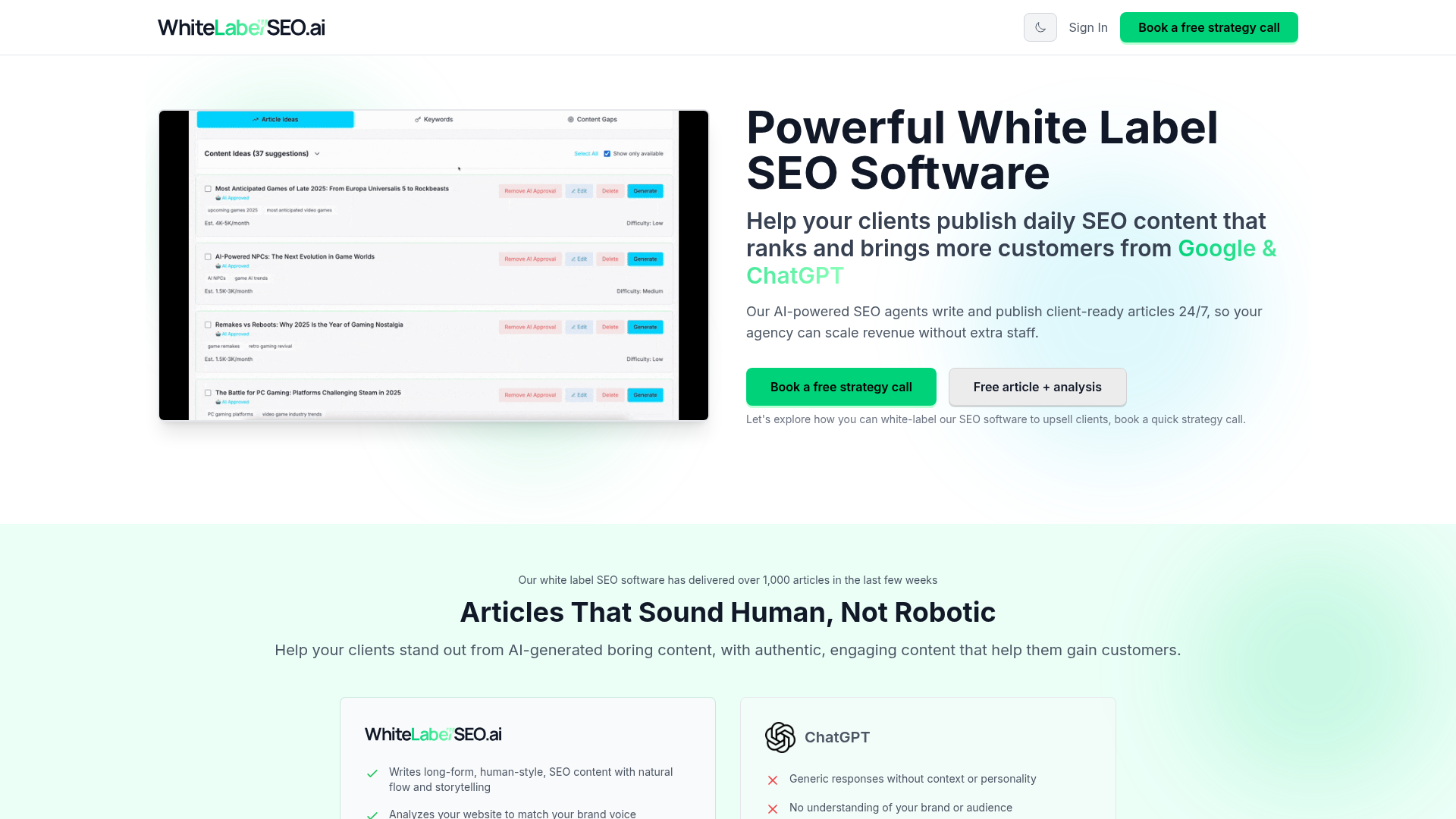
Whitelabelseo.ai is built for agencies and growth-focused teams that need to automate SEO content production without losing quality, consistency, or polished client delivery. It goes beyond a basic AI writer and works more like an operational layer for scaling content services, which is an important difference. The platform brings together AI-powered article creation, technical SEO support, white label workflows, CMS integration, brand voice customization, and content repurposing in one place. That makes it a practical fit for SEO agencies, digital marketing firms, SaaS companies, e-commerce brands, and freelancers that need to increase output while keeping control over presentation and final deliverables.
Core Features
- AI-powered SEO content generation for blogs, landing pages, and larger publishing campaigns
- White label delivery designed for agencies handling multiple clients
- Brand voice customization to keep AI-generated content aligned with each client or business
- CMS integrations that support easier publishing workflows
- Technical SEO support alongside content automation
- Content repurposing workflows that turn existing assets into additional formats
- Agency-friendly operations for scaling managed SEO services
Pros
- Built for agencies: The platform is clearly organized around multi-client delivery, which gives it an edge. Teams that rely on repeatable systems rather than one-off content drafts will likely notice the benefit early.
- White label ready: This is one of the platform’s biggest differences. Agencies can present deliverables under their own brand instead of sending clients into a third-party tool environment.
- Brand voice control: For teams producing content across different industries, tones, and audiences, this kind of customization helps reduce the generic feel that often appears in AI-assisted writing.
- Workflow efficiency: Because it combines content creation, optimization, and publishing support, the platform can reduce tool sprawl and limit friction between handoffs.
- Can grow with your service model: It suits businesses that want to expand content operations without needing to dramatically increase headcount on writing teams.
Who It’s For
This platform is a strong match for SEO agencies, white label service providers, digital marketing firms, SaaS startups, e-commerce teams, and freelancers that need to produce AI-driven SEO content at scale while keeping delivery polished and client-friendly. It also works well for teams managing several brands or client accounts that each have different voice, workflow, and publishing needs.
Unique Value Proposition
Whitelabelseo.ai stands out because it addresses a real operational gap. Many AI tools generate text, and many SEO platforms provide recommendations, but fewer are built around how agencies and service providers actually run their business. White label presentation, brand voice customization, technical SEO support, and CMS workflow alignment are all practical needs when SEO is delivered as a productized service. Instead of asking teams to patch together separate tools for writing, optimization, and delivery, it offers a more connected way to scale content production under an agency’s own brand without relying on a fragmented stack.
For deeper evaluation, see our SEO Automation Platform Checklist for Agency Buyers to understand what to look for when selecting a content automation platform.
Real World Use Case
Consider a mid-sized SEO agency onboarding five new SaaS clients in a single quarter. Rather than hiring several new writers and editors right away, the team uses the platform to generate client-specific content that matches each brand voice, move drafts through CMS workflows, and deliver the final output as a branded service. Turnaround gets faster, and the added growth is easier to manage.
Pricing: Contact for pricing
Website: https://whitelabelseo.ai/
A lot of buyers get stuck comparing platforms only by feature lists, but fit usually matters more in practice. A strong seo automation platform should match how a team actually works day to day. The comparison below focuses on where these four options differ in practical terms, because that is usually where the decision starts to become clearer.
| Company | Key Features | Pros | Cons | Pricing |
|---|---|---|---|---|
| Whitelabelseo | AI SEO content generation, white label workflows, brand voice customization, CMS integrations, technical SEO support | Agency-focused, scalable, white label ready, multi-brand support, streamlined delivery | None | Contact for pricing |
| Jasper | AI writing, brand voice tools, campaign assets, templates, collaboration features | Strong writing interface, broad use cases, established brand | Not SEO-first, can require extra optimization tools, pricing can climb with team usage | Creator from about $49/mo; Pro custom |
| Surfer | Content editor, SERP analysis, topical suggestions, content scoring, optimization workflows | Excellent on-page guidance, SEO-focused recommendations, useful audits | Less of a full white label system, AI content often needs editorial oversight, can be expensive for smaller teams | Essential from about $99/mo; higher tiers available |
| WriterZen | Keyword research, topic discovery, content creation, plagiarism checking, workflow tools | Good research stack, helpful topic clustering, relatively accessible pricing | Lighter agency white label depth, fewer enterprise workflow features, may need other tools for delivery | Plans typically start around $75/mo |
Are you deciding between a writing tool, an optimization tool, and a true operational platform? That difference is often what separates one option from another.
2. Jasper
At a Glance
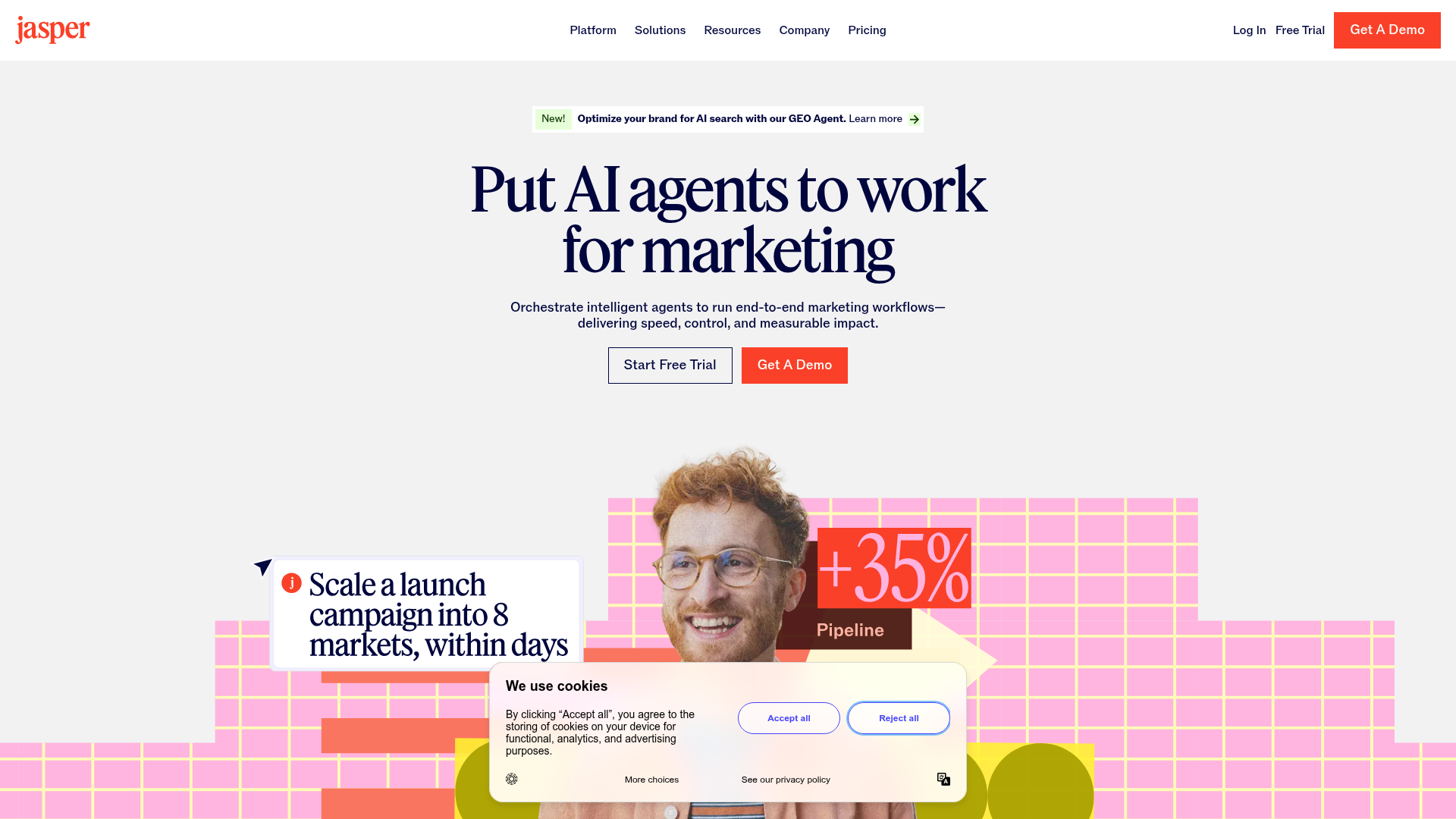
Jasper is one of the more familiar AI writing platforms used in marketing. It started as an AI copywriting tool and later expanded into a broader marketing workflow platform, adding brand voice features, campaign content generation, collaboration tools, integrations, and related features. For teams evaluating a content automation platform, Jasper often makes the shortlist because it’s easy to adopt and useful beyond SEO. It can support ads, email, social content, and brand messaging, which gives it broad coverage. That range is part of what makes it appealing. Still, it tends to work better as a content creation layer than as a full SEO system, which matters if SEO is the main priority.
For comparison, explore Best AI SEO Automation Platforms for Agencies to see how Jasper aligns with agency workflows.
Core Features
- AI writing for blogs, ads, emails, and other marketing assets
- Brand voice and style guide support
- Collaboration tools built for marketing teams
- Templates and guided workflows
- Browser extension, plus integration options
- Campaign-oriented content creation
- Knowledge and context features for consistency
Pros
- Strong usability: The interface feels polished and easy to use. Most teams get comfortable with it quickly.
- Versatile output: Jasper supports many content types, not just blog posts.
- Brand support: Voice controls help larger teams keep messaging more consistent.
- Broad ecosystem fit: Jasper connects easily with existing marketing stacks, which reduces setup friction.
- Recognized brand: Its established place in the market can make buyers more comfortable during evaluation.
Cons
- Not SEO-native enough for some teams: A separate optimization platform may still be needed for SERP-driven content strategy.
- Limited white label relevance: Agencies that want branded client delivery may find it less suited to that model.
- Costs can increase: As usage grows and team features are added, pricing can become harder to justify at scale.
Who It’s For
Jasper fits marketing teams that want AI support across multiple channels, especially if they need fast content generation for campaigns, internal workflows, and broader copywriting work. It can also work for SEO teams. In practice, though, it usually makes more sense as one part of a larger stack rather than the single source of truth.
Unique Value Proposition
Flexibility is Jasper’s clearest advantage. Rather than staying narrowly focused on SEO content production, it supports a wider range of marketing creation tasks. That makes it useful for organizations that want one AI writing environment shared across departments. Its value is clearest in cross-functional use. Teams focused mainly on SEO automation, however, will still need separate research, optimization, and publishing systems to complete the workflow.
Pricing: Creator from about $49/month; Pro and Business tiers available
Website: https://www.jasper.ai
3. Surfer
At a Glance
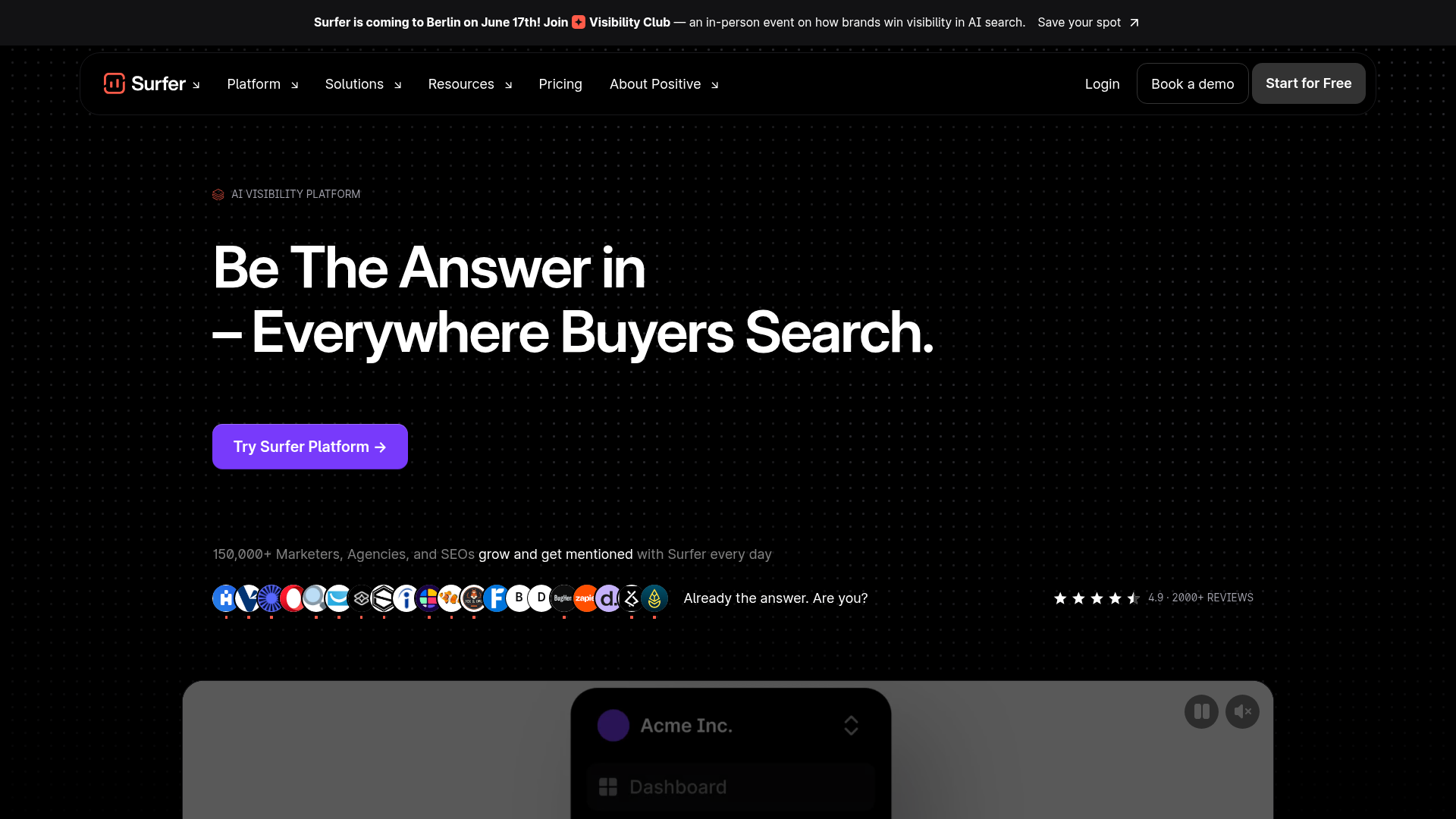
Surfer is one of the more established names in SEO content optimization, and that reputation still comes largely from its approach based on search data for on-page work. It now includes AI features and content generation support, but the main benefit is still tied to analyzing search results, recommending terms and structure, and assigning content scores that reflect actual ranking patterns. For businesses looking for a seo automation platform, Surfer is especially useful because it brings SERP analysis directly into the content workflow, where many teams struggle to stay consistent. That practical structure is a real advantage. It fits especially well for teams that already have writers or editors in place and want stronger optimization guidance built into the way content is produced.
For additional insight, review AI SEO Automation Systems: Build Repeatable Quality to learn how optimization tools integrate with automation frameworks.
Core Features
- Content Editor with optimization scoring
- SERP-based keyword and topical recommendations
- Audit tools for existing content
- AI-assisted content workflows
- Keyword clustering and planning support
- Team collaboration options
- Integrations with common writing workflows
Pros
- Excellent optimization depth: If current rankings are driving the strategy, Surfer gives strong on-page guidance based on what is already performing in search.
- Useful for updating old content: The audit tools can quickly point out areas to improve, which helps teams save time.
- Clear scoring system: Measurable optimization targets are useful for teams, and progress is easy to track.
- SEO-first design: Instead of acting like a generic AI writing tool, it is built around search performance.
Cons
- Not a full white label platform: Agencies may still need separate systems for client delivery and branded workflows.
- Content still needs human review: A strong optimization score does not automatically mean the content is readable or original.
- Pricing can feel premium: Smaller businesses may find it expensive, especially when it is used alongside other tools.
Who It’s For
Surfer works well for SEO teams, content marketers, publishers, and agencies that already have a production process and want deeper optimization insight within it. It is particularly useful for businesses focused on improving rankings through on-page refinement and structured content updates.
Unique Value Proposition
Its strongest advantage is the discipline it adds to optimization. Surfer helps close the gap between writing content and shaping that content to compete more effectively in search results. A team may already know what it wants to publish and simply need direction grounded in the SERP. In that situation, Surfer can be very effective. If white label scalability and broader service delivery are also required, though, it is not enough on its own.
Pricing: Essential plans commonly start around $99/month, with additional tiers available
Website: https://surferseo.com/
4. WriterZen
At a Glance
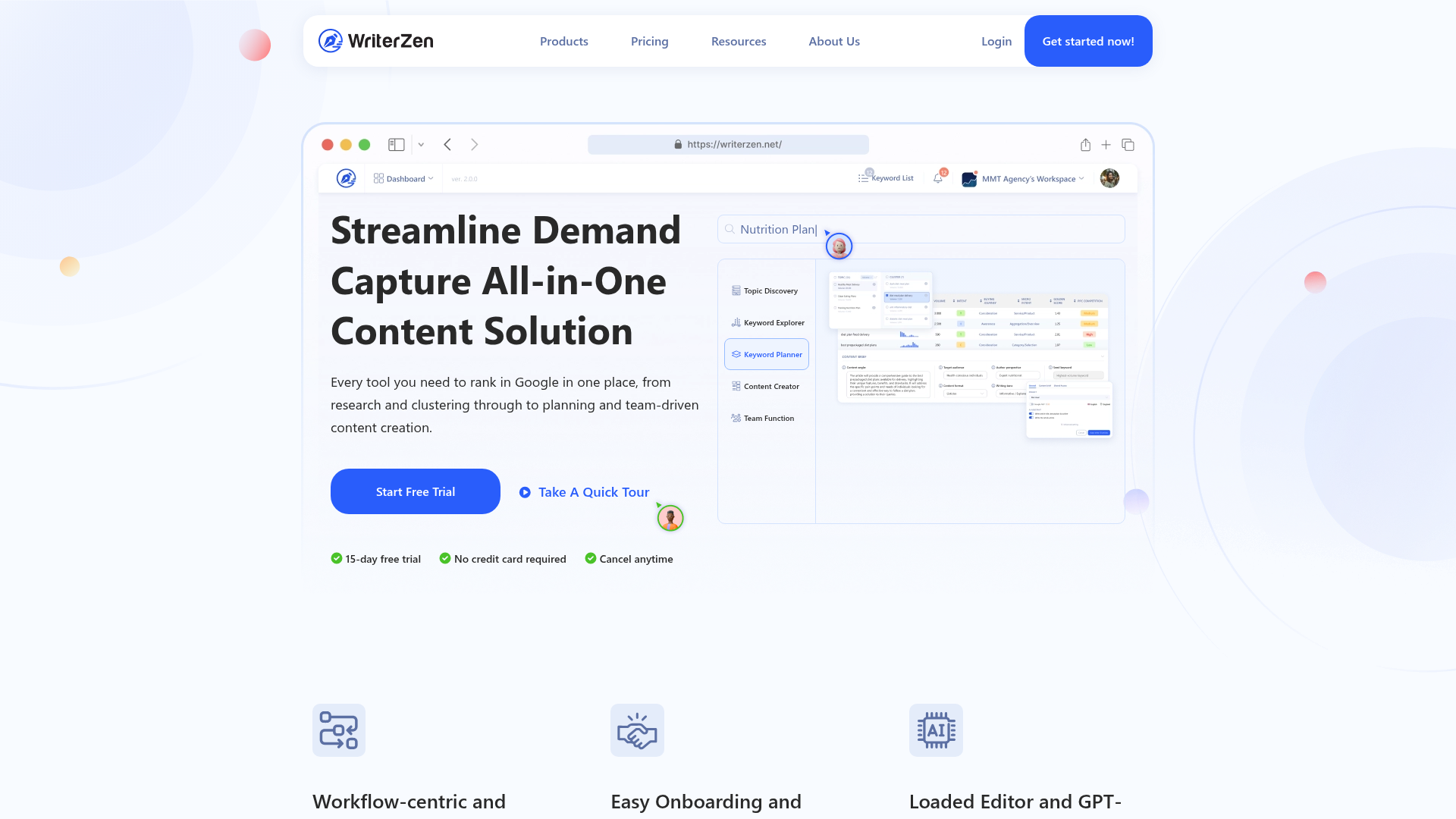
WriterZen combines keyword discovery, topic clustering, AI-supported writing workflows, and content planning in one place. That middle-ground position is a big part of why people like it. Smaller agencies, niche site builders, freelancers, and lean in-house teams often consider it because it links keyword research with content creation in a way that feels practical. For teams choosing a content automation platform, WriterZen is a good fit when the goal is a structured path from search insights to article production without paying for heavier enterprise systems and the extra complexity that usually comes with them.
Core Features
- Keyword research and opportunity discovery
- Topic clustering for content planning
- AI writing assistance
- Content creation workflow tools
- Plagiarism checker
- Search intent support for topic mapping
- Team collaboration basics
Pros
- Good research value: It brings together useful keyword and topic tools in a single platform.
- Helpful clustering: Strong for building topical authority plans and keeping content ideas organized.
- Accessible entry point: Pricing is easier for smaller teams to justify, especially when budgets are tight.
- Balanced feature mix: It handles planning and writing better than many lighter tools.
Cons
- Less solid for agency delivery: White label features and advanced client workflow support are not its strongest areas.
- Lighter operational depth: Teams running large multi-client systems may outgrow it over time.
- May require extra tools: Publishing, advanced optimization, or technical SEO may still need to be handled elsewhere.
Who It’s For
WriterZen suits freelancers, smaller agencies, affiliate marketers, startup teams, and content-focused businesses that want a manageable mix of keyword research and AI-assisted creation. It also works well for teams that care as much about planning structure as drafting support, since that cuts down on the need to jump between disconnected tools.
Unique Value Proposition
What stands out most is how WriterZen makes topic discovery and content planning simpler. It helps users turn keyword opportunities into organized content calendars without the complexity common in enterprise platforms, which makes it especially appealing for smaller teams. For businesses with simpler workflows, that makes it a good option. Teams built around high-scale white label service models will usually need something more specialized for agency operations.
Pricing: Plans commonly start around $75/month depending on package and billing structure
Website: https://writerzen.net
How to Choose the Best Fit for Your SEO Workflow
The right platform has less to do with the longest feature list and more to do with the kind of content operation you’re building. SEO agencies usually need client segmentation, faster onboarding, repeatable production, documentation, brand voice control, and some level of white label presentation. SaaS companies often put more weight on product-led content growth, CMS integration, and a clear connection to pipeline. E-commerce brands tend to focus on category pages, blog support, and efficient growth across large inventories. The priorities are different, and they shape what a good fit actually looks like.
For most buyers, these are the categories worth evaluating first:
- Content quality control: Can the platform help maintain useful, readable, on-brand output?
- SEO workflow depth: Does it support planning, optimization, publishing, and iteration?
- Scalability: Can your team manage 10 pages a month now and 200 later without rebuilding the process?
- White label capability: If you serve clients, can the platform support your brand instead of competing with it?
- Integration readiness: Does it connect well with your CMS and broader marketing stack?
- Operational efficiency: Will it reduce manual handoffs, review bottlenecks, or uneven delivery?
That’s why Whitelabelseo.ai ranks first in this comparison. It’s built to solve more than faster writing. The bigger issue for many agencies and growth teams is turning AI-assisted SEO into a service or system that can grow while staying consistent, client-ready, and manageable over time. That’s the harder problem, and it’s the one the platform is built around.
For an example of integrating technical SEO within content automation, see Technical SEO Integration for Headless CMS Platforms.
Why Whitelabelseo Leads This List
Many platforms in this category are either very good at writing support or especially strong on optimization guidance. What’s much less common is a tool that connects those strengths with the commercial demands of agency work and outsourced SEO delivery. That’s the difference that gives Whitelabelseo the clearest advantage.
For agencies, the white label element is not just a surface-level feature. It sits much closer to the core business model. Clients expect results, organized processes, and professionalism, but they do not always want to be pushed into a third-party software relationship. Automating content creation while keeping your own service identity in place can directly affect retention, margins, and the ability to grow, especially for teams trying to expand without adding more process friction.
The value looks different for SaaS and e-commerce teams. Brand voice consistency, CMS alignment, and technical SEO support help reduce the friction that comes from relying on separate tools at each stage. Instead of piecing together one platform for drafting, another for optimization, another for publishing, and yet another for client delivery or internal documentation, teams can work within a more unified system.
That does not mean the other platforms on this list are lacking. Jasper offers flexibility, and Surfer stands out for optimization. WriterZen adds solid planning and research value. But for teams aiming to build a repeatable, agency-friendly, AI-driven SEO content system, Whitelabelseo is the strongest fit of the four.
Ready to Scale SEO Content Without Breaking Your Workflow?
Many agencies and growing marketing teams get stuck with disconnected AI writers, SEO tools, spreadsheets, and manual client handoffs. Publishing more content may sound simple, but the day-to-day reality is usually messier: quality becomes inconsistent, copy starts to feel generic, approvals slow down, editors get overloaded, and workflows become harder to manage as more clients or brands are added. If that sounds familiar, the operational strain is probably already clear.
A strong content automation platform should do more than speed up drafting. It should support a system that can grow efficiently while still protecting credibility and keeping processes under control. That is where Whitelabelseo stands out. It brings together content creation, brand voice control, technical SEO support, white label delivery, and CMS workflow needs in a way that fits real service operations instead of disconnected content experiments.
For teams that want to automate more intelligently without lowering brand or delivery standards, Whitelabelseo.ai is worth a closer look. It offers a practical next step for agencies, SaaS teams, e-commerce brands, and freelancers ready to make AI-driven SEO a more reliable engine for growth, especially when scaling without adding more operational drag is the priority.
For extended reading, explore AI Content Customization for Google, ChatGPT & CMS to see how AI content can be aligned with specific platforms.
Frequently Asked Questions
Start with the fundamentals: content quality, SEO optimization support, workflow automation, integrations, scalability, and brand control. If you run an agency or manage multiple brands, white label capabilities and voice customization become especially important. A platform should help you produce more content without making your approval, editing, and publishing process harder to manage.
Look beyond how fast it generates drafts. The real test is whether it improves ranking performance, publishing consistency, organic traffic growth, and operational efficiency over time. Review how well the platform supports keyword targeting, internal processes, editing workflows, and measurable ROI. For agency-style operations, a platform like Whitelabelseo.ai is relevant because it addresses not only output speed but also delivery structure and brand alignment.
Pricing varies widely. Entry-level tools may start around $50 to $100 per month, while more advanced platforms with collaboration, workflow depth, or enterprise features can cost significantly more. Some platforms also use custom pricing for agencies or higher-volume users. In most cases, buyers should compare total workflow value rather than base subscription price alone.
Operational improvements can show up quickly, often within days or weeks, because teams publish faster and reduce manual work. SEO performance gains usually take longer. Depending on your site authority, competition level, and content quality, meaningful organic results may take several weeks to several months. Automation helps speed production, but search performance still depends on strategy, relevance, and consistency.
SEO agencies, digital marketing firms, SaaS startups, e-commerce brands, affiliate publishers, and freelancers often benefit the most. The common thread is the need to produce useful content at scale. Businesses managing multiple clients, high publishing volume, or complex editorial workflows usually see the greatest return from a structured platform.
For many agencies, yes. White label capability can improve client presentation, reduce platform friction, and help maintain a stronger service identity. It also makes it easier to standardize delivery across accounts. If white label support is central to your business model, platforms designed with that in mind, such as Whitelabelseo.ai, are generally more practical than generic AI writing tools.