Best Rank Tracker Tools for SEO Agencies

Choosing the best rank tracker sounds straightforward until one person has to report on results across dozens of clients, markets, devices, and locations. For an agency, a keyword rank tracker is more than a convenience. It shapes how quickly the team can spot wins, catch drops, prioritize work, and show clients the value of what they do.
Rank tracking sits within a much larger SEO system. Google says its ranking systems evaluate signals across hundreds of billions of web pages and other content in its index (Google Search Central). And Conductor’s 2025 State of SEO report still listed keyword rankings among the top metrics teams monitor, alongside organic traffic and user engagement (Conductor).
Picking the best rank tracker comes down to something practical: which tool gives an agency reliable visibility without slowing down delivery, reporting, or growth? A look at the leading options in this category points to four tools that stand out, each for a different reason: AccuRanker, SE Ranking, Semrush, and Ahrefs. All can work well. Still, each one is generally a better match for a slightly different agency need.
What we’ll cover in this best rank tracker guide
- AccuRanker
- SE Ranking
- Semrush
- Ahrefs
The SEO software market is getting more crowded. Fortune Business Insights values it at USD 97.7 billion in 2026 and expects it to reach USD 271.9 billion by 2034, with a 13.65% CAGR from 2026 onward (Fortune Business Insights). Technavio also points the same way, projecting USD 48.10 billion in market growth at a 21.6% CAGR across 2026 to 2030 (Technavio).
| Source | Metric | Value | Period |
|---|---|---|---|
| Fortune Business Insights | SEO software market size | USD 97.7B | 2026 |
| Fortune Business Insights | Projected market size | USD 271.9B | 2034 |
| Fortune Business Insights | CAGR | 13.65% | 2026 onward |
| Technavio | Expected market growth | USD 48.10B | 2026, 2030 |
| Technavio | CAGR | 21.6% | 2026, 2030 |
Agencies have more software options than ever. That sounds useful, but in practice it doesn’t make the decision any easier, especially when the right keyword tracking tool needs to match the service model, reporting style, client volume, and the rest of the stack.
Teams comparing broader workflow platforms may also want to review Agency SEO Tools for Content Ops and Client Delivery alongside these rank-tracking options.
Four best rank tracker tools worth considering
AccuRanker
At a Glance
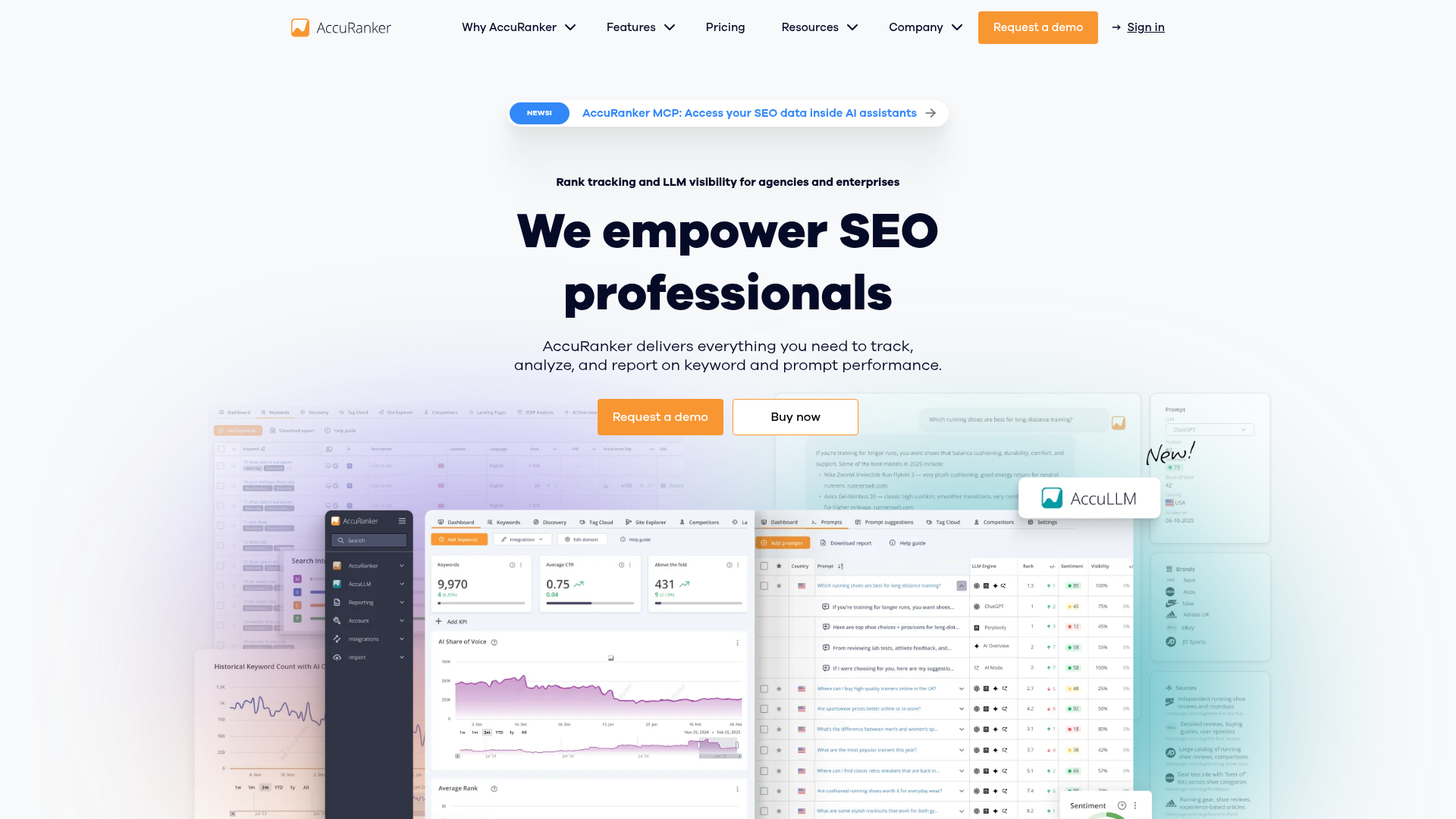
AccuRanker focuses on one job: tracking rankings at scale with speed and precision. For agencies, that focus can be its biggest advantage. Instead of trying to cover every SEO task, the platform stays centered on fast updates, flexible segmentation, competitor monitoring and reporting. It’s especially appealing to teams managing large keyword sets across many clients because it cuts the lag between a ranking change and when the team notices it. Agencies that want a dedicated rank tracker, not a broad SEO suite with tracking added as a secondary feature, will find AccuRanker one of the strongest options available.
Core Features
- Real-time and on-demand rank updates
- Keyword tagging and advanced filtering
- Competitor tracking and SERP analysis
- Agency-friendly reporting dashboards
- Integrations with wider SEO stacks
- AI and LLM visibility features through AccuLLM-related capabilities
- Unlimited users, domains and API calls noted in available research
Pros
- Built for rank tracking first: The product is designed for agencies that care deeply about keyword movement, and that priority is clear.
- Fast refresh capability: On-demand updates give teams a real operational edge when clients want answers quickly.
- Scales well: Large keyword portfolios are easier to manage with tags, filters and segmentation.
- Strong reporting flow: Clean dashboards help agencies turn ranking data into client communication with less friction.
- Good for technical teams: API flexibility makes it easier to connect the tool to custom reporting workflows.
Cons
- Higher cost: It can be pricier than more general alternatives.
- Narrower product scope: Agencies that also need audits, content tools and backlink research in one subscription may view the platform as incomplete.
- Potential overkill for small retainers: Smaller agencies may not make full use of its specialist strengths.
Who It’s For
AccuRanker is best suited to agencies that treat SEO as a serious ongoing service rather than a light add-on. It works well for teams handling high keyword volumes, multiple reporting layers or enterprise-style clients that expect quick ranking answers and clearer visibility reporting.
Unique Value Proposition
Its focus is what makes AccuRanker stand out. Many tools offer rank tracking, but AccuRanker builds the entire product around it. That gives agencies sharper day-to-day visibility, faster updates and a cleaner way to isolate ranking changes without getting pulled into extra modules they may not need.
Pricing: Public 2026 pricing snapshots in the research include $129/month for 1,000 keywords, with some sources also citing $224/month billed yearly or $249/month for 2,000 keywords depending on plan and source period.
Website: https://www.accuranker.com
SE Ranking
At a Glance
SE Ranking works well for many agencies because it combines rank tracking with a broader set of SEO workflow tools. It covers rankings, audits, keyword research, backlinks, and reporting in one place. It also offers white-label options, which matter for agencies serving clients under their own brand. If AccuRanker is the specialist pick, SE Ranking is the practical operator: capable, flexible, and easier on the budget in many cases. That mix makes it a strong keyword tracking tool for agencies that need more than ranking data and don’t want to pay premium-suite prices from the start.
Core Features
- Rank tracking across locations and devices
- Website auditing tools
- Backlink analysis and monitoring
- Keyword research features
- Client reporting and collaboration tools
- White-label functionality through Agency Pack
- Local SEO support for multi-location work
Pros
- Strong value for money: Agencies get a lot beyond rank tracking without moving into enterprise-level spend.
- Agency-focused options: White-label customization supports client-facing delivery.
- Balanced feature mix: It fits teams that want ranks, audits, and research in one place.
- Accessible workflow: Smaller teams can get started without a long ramp-up.
- Useful for local and regional campaigns: Daily tracking and local support make it practical for varied client portfolios.
Cons
- Some advanced features may cost extra: Agencies can outgrow lower tiers or need add-ons.
- Less specialized than a dedicated tracker: Power users may prefer a tool built purely for ranking intelligence.
- Database depth can trail larger suites: Bigger platforms may feel stronger for some research-heavy tasks.
Who It’s For
SE Ranking fits growing agencies, freelancers with multiple clients, and lean teams that want one platform to handle reporting, rank checks, and core SEO work. It stands out when white-label delivery matters and budget discipline does too.
Unique Value Proposition
SE Ranking’s advantage isn’t its depth in any single category. It gives agencies a usable all-in-one system, with rank tracking at the center and client-ready presentation built in. Agencies can standardize delivery across accounts without juggling as many separate tools.
Additionally, agencies comparing broader reporting stacks can review Best Agency SEO Tools for White-Label Delivery for related platform options.
Pricing: Public pricing found in research includes plans from $65/month, with one 2026 annual Core snapshot at $103.20/month and some comparison sources citing $129/month for 2,000 keywords depending on configuration and source period.
Website: https://seranking.com
Semrush
At a Glance
Semrush is one of the best-known platforms in SEO, and not just for rank tracking. Its Position Tracking tool is part of a much larger suite that also includes keyword research, backlinks, site audits, competitor analysis, PPC insights, and broader digital marketing intelligence. For agencies that want one central platform instead of juggling a stack of point tools, that setup can be appealing. The trade-off is cost and complexity. Teams that mainly want a strong rank tracker, rather than a full marketing system, may find Semrush heavier than they need. For broader agency needs, it still stands out as a serious contender.
Core Features
- Position Tracking for organic visibility monitoring
- Keyword research and competitor intelligence
- Backlink analysis tools
- Site audit capabilities
- Content and planning tools
- PPC and market research features
- Local rank tracking through the Local toolkit
Pros
- Broad feature coverage: A strong fit for agencies that want research, tracking, and competitor insights in one ecosystem.
- Well-established platform: Mature workflows and wide product breadth support multi-service agencies.
- Useful for cross-channel teams: SEO and paid search teams can work in the same environment.
- Good for enterprise-style operations: Supports larger, more complex marketing needs.
- Strong market adoption: In a 2025 survey of 123 respondents, 71% reported using Semrush (CodeRenowned).
Cons
- Premium pricing: Costs can climb quickly, especially once seats and extras start adding up.
- Not the leanest option: Teams that want a pure keyword rank tracker may end up paying for features they don’t use.
- Can feel busy for smaller agencies: It’s a powerful platform, but smaller teams need more process discipline to use it well.
Who It’s For
Established agencies, in-house teams handling agency-level complexity, and firms that offer SEO alongside PPC, competitive research, and content strategy will get the most from Semrush. It makes the most sense when a team wants a broad suite and sees rank tracking as just one part of a much bigger buying decision.
Best rank tracker workflows and reporting depth
Agencies often compare Semrush with other suites because reporting depth and workflow integration matter just as much as raw ranking data. Teams balancing technical SEO, content strategy, and local campaigns may also find value in guides such as Best SEO Audit Tools for Agencies and SaaS Teams.
Unique Value Proposition
Semrush stands out for consolidation. Agencies looking for fewer logins and clearer visibility across channels can get more out of rank tracking when it connects directly to keyword research, audit data, and competitor context in the same platform.
Pricing: Public 2026 pricing snapshots in the research cite a starting price of $139.95/month for the Pro plan, and some comparisons tie that entry tier to 500 tracked keywords.
Website: https://www.semrush.com
Ahrefs
At a Glance
Teams choose Ahrefs for backlink intelligence and deep keyword research. Its Rank Tracker gives agencies a solid way to monitor rankings as part of broader SEO work. It works best when ranking movement is only one part of the story and teams need to connect changes to links, content opportunities, competitor pages, and historical performance. It’s less specialized than AccuRanker when rank tracking is the only focus. Still, it becomes more useful than many lighter tools when research depth matters more. For backlink-led SEO teams, Ahrefs belongs on the shortlist.
Core Features
- Rank Tracker for keyword monitoring
- Site Explorer for backlink and competitor analysis
- Keywords Explorer for research and planning
- Site Audit tools
- Historical ranking data
- Reporting and dashboard capabilities
- Broader visibility features in the expanding product ecosystem
Pros
- Excellent backlink data: Especially useful for agencies where off-page work shapes reporting and strategy.
- Strong keyword research engine: Makes it easier to pair tracking with opportunity discovery.
- Useful historical context: Helps agencies diagnose longer-term ranking movement.
- Trusted by practitioners: In a 2025 survey of 123 respondents, 85% reported using Ahrefs (CodeRenowned).
- Solid fit for research-led SEO teams: Good for teams that care as much about strategy and diagnostics as raw position checks.
Cons
- Refresh frequency may lag specialist tools: Some comparisons point to weekly refreshes in certain contexts.
- Can be costly for tracking-first use cases: If rankings are the only priority, the research depth may exceed what some teams need.
- Some limits and add-ons matter at scale: Larger agency reporting needs may require a closer review of plan details.
Who It’s For
Ahrefs fits agencies that build strategy from backlink analysis, content gap research, and competitive intelligence, then want rank tracking connected to that wider view. It also suits research-heavy SEO teams that don’t want rankings separated from the rest of their analysis stack.
Unique Value Proposition
Ahrefs stands out by making rank tracking part of diagnosis rather than a standalone report. If a keyword drops, agencies can use the platform to check whether backlinks, competitors, content gaps, or broader visibility shifts are influencing the change, not just the position.
Pricing: Public research snapshots cite $129/month for the Lite plan. Some sources also mention a $29/month Starter option, though they describe it as not being a full rank-tracking plan. In some 2026 comparisons, Lite is linked to 750 tracked keywords.
Website: https://ahrefs.com
How these best rank tracker tools compare on hard numbers
For agencies, the clearest differences generally come down to price, keyword capacity snapshots, and product maturity. The figures below rely only on the public data points in the supplied research, with the relevant time period shown where that matters.
| Tool | Founded | Starting Price Snapshot | Tracked Keywords Snapshot | Notes |
|---|---|---|---|---|
| AccuRanker | 2013 | $129/mo | 1,000 | 2026 pricing snapshot; other sources cite $224, $249 for 2,000 keywords |
| SE Ranking | , | $65/mo | 750 | Public lower-tier snapshot from comparison research |
| Semrush | 2008 | $139.95/mo | 500 | 2026 snapshot tied to Pro/Position Tracking context |
| Ahrefs | 2010 | $129/mo | 750 | Lite plan snapshot; Starter mentioned separately as not full tracking |
In pure pricing snapshots, SE Ranking looks like the value option. AccuRanker remains the stronger tool for specialist rank-tracking speed and focus, while Semrush and Ahrefs justify the higher spend when an agency also relies on broader research, competitive analysis, or channel planning.
What agencies should actually look for in a keyword tracking tool
Many roundup articles stop at feature lists. Agencies should pick tools based on their workflow instead. In practice, selecting the right keyword tracking tool comes down to five questions.
1. Fresh ranking data matters most when clients expect rapid reporting
When clients expect rapid reporting after launches, migrations or link pushes, update speed matters. In those moments, dedicated tools such as AccuRanker can stand out. If daily checks, or anything less frequent, are enough, all-in-one suites may be perfectly fine. Sometimes they are.
2. Is rank tracking the product, or just one proof point?
Some agencies sell visibility reporting directly. Others go broader, selling growth strategy, content, technical SEO, and digital performance as part of a wider offer. If rank tracking sits at the center of the service promise, specialist depth matters much more. If it’s just one layer in a broader package, suite tools start to look more appealing.
3. White-label reporting
For agencies, white-label reporting is a real differentiator. SE Ranking stands out here: its FAQ describes White Label functionality that lets agencies personalise the interface, use a custom domain, and send reports via SMTP (SE Ranking). It’s not a minor extra. If client-facing brand consistency matters, agencies shouldn’t treat white-label reporting that way.
Additionally, agencies managing AI visibility alongside rankings may benefit from reviewing AI SEO Metrics That Actually Matter: Tracking Rankings, Citations, and AI Mentions Together.
4. How much context do your strategists need?
A rank change without context creates noise. Search Engine Land says traditional rank tracking alone is no longer enough as a standalone SEO measurement approach (Search Engine Land). Ahrefs and Semrush remain popular because they connect rankings with backlinks, competitors, audits, and research.
5. Will the tool scale with your agency model?
In Conductor’s 2025 report, 91% of respondents said SEO had a positive effect on website performance and marketing goals in 2024. The findings came from a sample of 350+ digital marketing, SEO and content marketing professionals in North America (Conductor). The same report found that 31% reported dedicating 21, 40% of total marketing bandwidth to SEO in the previous 12 months (Conductor).
As SEO takes up a larger share of delivery, rank tracking stops being just a nice dashboard and starts working as operational infrastructure.
So which one should you pick?
Pick AccuRanker if you want the best specialist rank tracker. For agencies focused on ranking visibility, faster refreshes, and large-scale keyword monitoring, it’s the strongest option.
Choose SE Ranking if you want the best value all-in-one platform for agencies. It balances rank tracking, reporting, and broader SEO workflows well. It’s a solid middle ground. Its white-label options also make it particularly appealing for client service teams.
Go with Semrush if you want the best full-suite choice for larger agencies. If rankings are just one part of a broader SEO and marketing program, it makes a lot of sense.
If your agency is research-led and backlink-heavy, Ahrefs is the best fit. It combines tracking with the diagnostic depth strategists may want before making recommendations.
Make your rank tracker part of the system, not a silo
The smartest agencies don’t use rank tracking as a standalone report sent once a month. They use it as an early-warning system, a way to prioritize work and a tool for client communication, not a silo. Your best rank tracker should connect to content updates, technical fixes, reporting cadences, and account strategy instead of sitting on its own.
Process matters just as much as the software. A keyword tracking tool can show movement, but the team still needs a repeatable way to decide what changed, why it changed, and what action should follow. That part is easy to miss. Agencies handling traditional rankings, local visibility, and emerging AI search visibility within the same client relationship need that discipline even more.
If broader workflow support would help, Whitelabelseo.ai is a useful place to start. The platform helps agencies automate content creation, scale white-label SEO delivery, and connect SEO execution more directly to the systems behind growth.
Already comparing tools like these? Think one step beyond software selection. How will your agency turn ranking data into repeatable deliverables that clients can understand and keep buying? That’s the bigger operational issue. Whitelabelseo.ai offers a helpful perspective by focusing on scaling content, technical SEO, and white-label service delivery around the tools you choose. You can learn more through this AI-powered white-label SEO platform.