How Agencies Evaluate AI SEO Tools That Scale

If you’re comparing ai seo tools right now, you’re probably not looking for another shiny dashboard. What usually matters more is whether a platform helps your team produce more, standardize delivery, protect margins, and keep client work moving without creating extra mess behind the scenes, which happens more often than vendors admit. That is especially true for seo for agencies. The wrong platform can remove some work, but it can also add nearly as much back through handoffs, revisions, and reporting.
To put this guide together, I reviewed four platforms agencies often consider when they need automation, reporting, content operations, and white-label support. The goal was to find tools with AI features that still work well when an agency needs repeatable workflows, multi-client management, and delivery that can scale without breaking the process or forcing the team into workarounds. That is usually the difference between a tool that is genuinely useful and one that only looks good in a demo.
This comparison matters right now because agencies are under pressure to publish faster, show clearer ROI, and maintain quality across multiple accounts while AI shifts client expectations almost overnight. The strongest tools are no longer just research platforms. In this view, they are becoming operating systems for SEO production, bringing content planning, reporting, and multi-account workflow management together in one place.
What You’ll Find in This Comparison
- Whitelabelseo
- Semrush
- AgencyAnalytics
- SE Ranking
The 4 Platforms Agencies Will Probably Start With
1. Whitelabelseo
At a Glance
Whitelabelseo.ai is built for agencies that want to scale SEO delivery without patching together a stack of separate tools. Instead of treating AI as an extra assistant layered on top of existing software, the platform is organized around agency workflows like content automation, technical optimization, white-label delivery, brand voice matching, and CMS integration. That setup is practical, especially when a team is managing multiple client accounts and needs output that feels ready to publish in a client CMS or send for approval instead of sounding like obvious machine-written copy. For teams built around recurring SEO services, it stands out because it helps turn AI into a repeatable service model, not just a one-time productivity gain.
Core Features
- AI-powered SEO content creation built for scalable publishing
- White-label delivery for agencies serving clients under their own brand
- Brand voice customization that keeps outputs matched to client tone
- Technical SEO support that improves site health and optimization workflows
- CMS integrations for smoother publishing operations
- Content automation built for multi-client agency environments
- Workflow support for SaaS, e-commerce, and service-based SEO campaigns
Pros
- Built for agency scale: The platform is clearly aimed at agencies managing multiple client engagements, not just a single in-house website.
- White-label friendly: That is a major advantage for firms that need deliverables to feel like their own service rather than a third-party tool’s output.
- Brand voice control: Agencies can keep consistency across clients instead of ending up with generic AI copy that needs heavy rewriting.
- Operational efficiency: It brings content automation and SEO workflow support into one place, cutting down on tool switching and manual coordination.
- Useful for recurring delivery: It works well for retainer-based services because it supports repeatable content production and optimization over time.
Who It’s For
Whitelabelseo is a strong fit for SEO agencies, digital marketing firms, SaaS growth teams, e-commerce brands, and freelancers that need to produce SEO content and optimization work at scale while still keeping branded client delivery intact. That is a fairly broad mix, probably broader than some teams expect. It is especially useful for groups that want AI to support an ongoing service operation instead of simply generating rough drafts that someone has to fix later.
Unique Value Proposition
Many platforms specialize in research, while others focus on reporting. Whitelabelseo is centered on the part agencies often find hardest to scale: actual SEO production and fulfillment. Its mix of AI-generated content workflows, white-label positioning, CMS connectivity, and brand voice customization makes it especially relevant for agencies that sell SEO as an ongoing service. Instead of pushing teams to assemble separate tools for writing, editing, project management, optimization, and reporting, it helps centralize the execution side of agency SEO in a way that is easier to standardize across accounts. The practical difference here is fairly clear: less patchwork and more consistent delivery.
Teams that want a broader overview of Agency SEO Tools for Content Ops and Client Delivery will likely notice how much operational workflow affects long-term scalability. That becomes more obvious as client counts increase.
Real World Use Case
Picture a mid-sized agency managing content and SEO for twelve SaaS clients. Rather than coordinating freelancers, editors, optimization tools, and separate publishing workflows, the team uses Whitelabelseo to generate client-aligned content, keep a consistent voice, streamline handoff, and publish faster through CMS integrations. That usually means more control and fewer bottlenecks. In turn, the agency gets more predictable turnaround times without giving up its own service branding.
Pricing: Contact for pricing
Website: https://whitelabelseo.ai/
A lot of agency buyers compare platforms by asking a simple question: which one helps scale the most important workflows with the least friction? Looking at feature scope, agency fit, white-label support, and pricing posture side by side usually makes that comparison easier.
| Company | Best Fit | White-Label Support | Content/SEO Execution | Starting Pricing Context |
|---|---|---|---|---|
| Whitelabelseo | Agencies scaling SEO fulfillment | Built around white-label service delivery | Strong focus on AI content automation, brand voice, CMS workflows, and SEO operations | Contact for pricing |
| Semrush | Agencies needing broad all-in-one SEO research | Available depending on plan/workflow | Strong research, audits, competitor analysis, and content toolkit | Custom by plan; higher tiers often needed for advanced agency use |
| AgencyAnalytics | Agencies prioritizing reporting and client dashboards | Strong core strength | Reporting-focused rather than deep execution | $59/month entry, around $179/month for full white-label capability |
| SE Ranking | Agencies wanting balanced SEO tools with optional white-label | Available via Agency Pack/add-ons | Good rank tracking, audits, backlink and keyword workflows | $129/month plus $69/month Agency Pack often cited |
The table shows why these tools often appear on the same shortlist, but they address different agency needs. Whitelabelseo leans most heavily into fulfillment and scalable delivery. The others, by contrast, usually lead with research depth, dashboards, or broader reporting, which can be useful but serves a different purpose.
2. Semrush
At a Glance
Semrush is one of the best-known names in SEO software and has been used by marketers since 2008. For agencies, its main appeal is usually the breadth of the platform. It brings together keyword research, site auditing, competitor tracking, content workflows, reporting, and a broader digital marketing layer inside a mature system with strong market credibility. It also includes AI-assisted capabilities through workflow and recommendation features, which keeps it part of the discussion around modern ai seo tools. That wide scope is often exactly why agencies choose it. Teams looking for one large ecosystem for research, planning, and analysis will likely still see Semrush as a strong option, especially when strategy covers SEO, content, and digital marketing.
Core Features
- Keyword research, rank tracking, and domain visibility tools
- Site audit and technical SEO analysis
- Competitor research, along with broader domain analysis
- Content marketing toolkit
- AI-assisted recommendations through Semrush workflow features
- Reporting tools for internal teams and client use
- Broad digital marketing ecosystem beyond SEO
Pros
- Very thorough: It covers a wide range of SEO and marketing functions within a single platform.
- Trusted brand: Many agencies are already familiar with the interface, methodology, and reporting style.
- Strong competitor intelligence: Its market and domain analysis tools are especially useful for strategic planning.
- Solid technical toolkit: Site audits and tracking features support ongoing optimization work.
- Good for established teams: Agencies with specialized roles can often get substantial value from the platform’s depth.
Cons
- Can get expensive: Smaller agencies may start to feel pressure as additional seats, reports, and advanced features become necessary.
- White-label can be less straightforward: Some agencies need higher-tier plans or extra work to produce polished branded delivery.
- Steeper learning curve: Teams that want quick implementation may find the platform heavier than they need.
Who It’s For
Semrush is a strong fit for agencies that need broad research capabilities, detailed audits, competitive analysis, and a mature all-in-one platform. It tends to work especially well for firms with a dedicated SEO team that can make full use of its large feature set. It is also a good option for teams that do not want to patch together separate tools, since that can often become messy. Agencies serving clients who expect detailed strategic reporting and clearer justification for SEO decisions may also find it especially well suited to their needs.
Unique Value Proposition
Semrush stands out by bringing research, technical SEO, competitor analysis, and content planning into one well-known ecosystem. Agencies that need visibility into market opportunities and competitive gaps before shaping strategy can access a very broad toolset here. This is often most useful during planning, competitive reviews, and ongoing performance analysis. Its strength is centered more on strategic control over SEO decision-making than on white-label fulfillment, so that distinction is worth keeping in mind.
Additionally, agencies comparing broader AI-Powered SEO Automation: Best Practices for Agencies often evaluate Semrush alongside newer workflow-focused platforms. That comparison usually highlights the difference between research depth and operational execution.
Pricing: Public plans available; agency use often requires higher tiers depending on reporting and workflow needs
Website: https://www.semrush.com
3. AgencyAnalytics
At a Glance
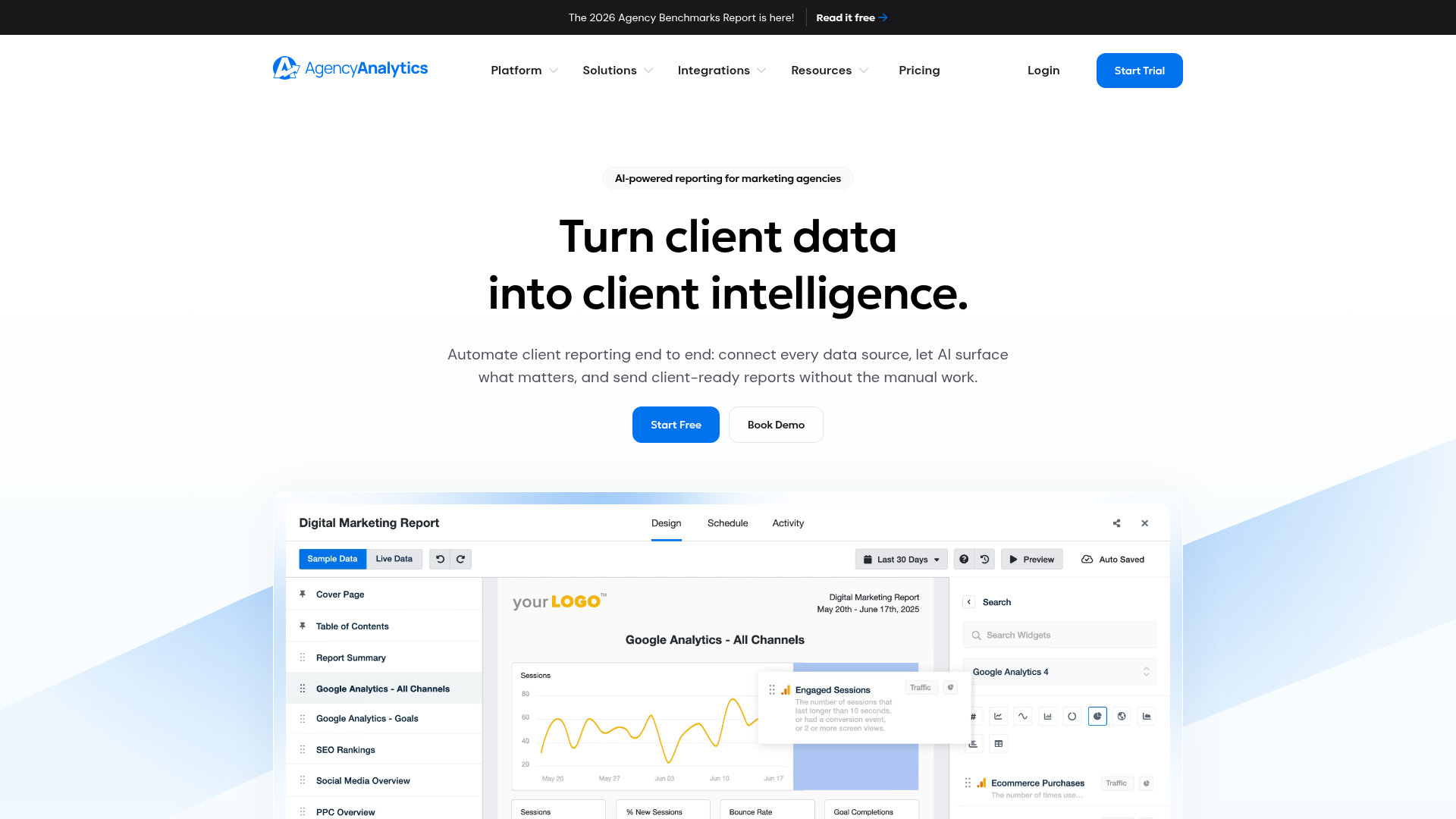
AgencyAnalytics is a platform built specifically for marketing agencies, and that focus is usually easiest to see in its reporting and client presentation features. Since 2009, it has become a popular choice for firms that need automated dashboards, branded reporting, and a simple way to bring together cross-channel performance data. In the context of seo for agencies, it is not a full SEO execution suite. Instead, it works more like a client communication tool, which is often where agencies feel the biggest gap. If the main challenge is showing value efficiently rather than handling deep technical research, AgencyAnalytics is a very practical fit.
Core Features
- White-label dashboards and reports
- Automated client reporting
- SEO performance tracking
- Integrations across marketing channels
- Branded client portals
- Agency-oriented workflow presentation
- Multi-channel reporting for SEO, PPC, and social
Pros
- Agency-first design: The platform is organized around how agencies present results to clients, not just how internal teams review performance data.
- Strong white-label reporting: Branded dashboards and reports are a major benefit for retention and professionalism, especially during client-facing monthly reviews.
- Easy to use: Teams can often get started quickly without a long setup process.
- Multi-channel visibility: It works well for agencies managing more than SEO, including PPC and social.
- Useful for recurring reporting: Automated reports help reduce repetitive monthly work.
Cons
- Not a deep SEO research suite: It does not replace tools made for advanced keyword research and backlink analysis.
- May require a second tool: Agencies often pair it with another platform for actual SEO execution, such as research or technical auditing.
- Value depends on reporting-heavy workflows: If client dashboards are not central to the delivery model, it can feel narrow and likely less necessary.
Who It’s For
AgencyAnalytics is best suited to agencies that need polished white-label reporting, client portals, automated monthly communication, and a simpler way to present results clearly. It is especially helpful for firms managing SEO alongside paid media or social campaigns that want a centralized reporting view for stakeholders without creating dashboards from scratch. When that part of the workflow is where a team gets stuck, the platform will often fit well.
Unique Value Proposition
Its clearest difference is presentation. That sounds simple, but here it matters. AgencyAnalytics helps agencies make their work visible, clear, and branded for clients. That matters because many agencies do strong work yet still struggle to package performance in a way clients immediately understand and appreciate. In practice, this leads to clearer dashboards, agency branding, and reports clients can review without much extra explanation. It is a reporting-first platform rather than a full SEO operating system, and that clear positioning is likely part of what makes it effective.
For agencies improving reporting alongside Content Performance Metrics for Automated SEO, tools like AgencyAnalytics can make recurring reviews easier to standardize. That tends to matter more as reporting volume grows.
Pricing: Commonly cited from $59/month; full white-label capability around $179/month
Website: https://agencyanalytics.com/
4. SE Ranking
At a Glance
SE Ranking has grown into a practical SEO platform for agencies that need rank tracking, audits, backlink monitoring, keyword research, and optional white-label features without moving straight to enterprise-level pricing. Founded in 2013, it often appeals to agencies that want dependable day-to-day operational coverage with a more accessible cost structure, which for many teams is a real consideration. In conversations about an agency stack, SE Ranking usually comes up as a practical middle-ground option. It offers more breadth than a reporting-only platform, costs less than some larger suites, and still stays flexible enough for agencies managing multiple client accounts.
Core Features
- Rank tracking
- Website audit tools
- Backlink monitoring
- Keyword research
- Competitor analysis
- Agency Pack and white-label options
- Lead generation widgets for agencies
Pros
- Balanced feature set: It covers the main SEO workflows most agencies rely on day to day, and that is a big part of the appeal.
- More accessible pricing: Growing agencies can often justify the cost more easily, which is a real advantage in everyday use.
- Agency-oriented options: White-label and lead generation features are useful for service businesses, especially when several client accounts are involved.
- Good operational utility: Rank tracking and audits are especially useful for recurring SEO work such as monthly reporting and ongoing site checks.
- Less overwhelming than bigger suites: Smaller teams may find it easier to adopt and use, which usually helps with onboarding too.
Cons
- White-label may cost extra: The Agency Pack is not always included by default.
- Less enterprise depth: Larger agencies may still prefer bigger platforms when they need broader advanced research and more extensive functionality.
- Lower brand recognition: Some clients are simply more familiar with larger legacy names, and that can affect how the tool is viewed.
Who It’s For
SE Ranking is a strong fit for small to mid-sized agencies that want a dependable SEO toolkit, optional white-label support, and manageable pricing. It is simple, clear, and a sensible choice. It works well for firms that need core SEO operations and client reporting support, with a more measured path to scale instead of committing too early to a top-tier enterprise suite. If the largest platform in the category is not necessary, this will often make practical sense.
Unique Value Proposition
SE Ranking offers a practical mix of affordability and utility. Agencies get rank tracking, audits, backlinks, competitor research, and client-facing features in one system, which often keeps operations simpler. That makes it attractive to firms that want enough depth to work professionally without paying for a much larger platform than they would actually use. In most cases, the value is fairly clear: useful coverage without the heavier cost or extra complexity.
Pricing: Commonly cited at $129/month plus $69/month Agency Pack for white-label functionality
Website: https://seranking.com
What Agencies Should Measure Before Choosing AI SEO Tools
The biggest mistake agencies make when comparing ai seo tools is giving too much weight to feature lists. Scale usually does not come from how many buttons a platform offers; that is often the easy part. What matters more here is whether the tool actually reduces friction across the workflow. In practice, that usually means looking at a few areas in a sensible order.
Start with production capacity. Can the platform help the team create and optimize more output without sacrificing quality? For many agencies, this is where a fulfillment-oriented platform may have an edge over one that leans more heavily on research. That is likely one of the clearest differences.
After that, review white-label readiness. When the service model depends on branded client delivery, this should not be treated as an afterthought. AgencyAnalytics is strong on reporting, while Whitelabelseo is more directly built for white-label SEO execution for client-facing delivery, which in most cases tends to be the real test.
It is also worth assessing integration depth early. A tool that generates content but does not connect cleanly with the CMS or fit naturally into the client workflow often adds hidden work. In many situations, that can matter more than a polished AI interface.
Another area to look at is multi-client management. The right platform should support repeatability across accounts rather than helping with only one strong campaign. Agencies often outgrow tools that are technically powerful but awkward in day-to-day use, and that can be easy to miss, especially when demos look polished.
Finally, compare margin impact. A platform is scalable only if it improves the economics. Lower production time, faster onboarding, cleaner reporting, and less editing all affect profitability directly. For that reason, this part should probably be weighed as carefully as the feature set.
Agencies evaluating SEO Automation Platform Checklist for Agency Buyers often use these same criteria to compare operational fit before committing to a larger software stack. That can prevent expensive workflow changes later.
How They Stack Up in Practice
When agencies compare platforms in real-world use, they usually weigh strategic SEO depth, execution speed, client-facing delivery, and the tradeoffs that come with each. Being clear about those tradeoffs often helps avoid buying regret, which can be expensive and hard to undo.
| Company | Key Features | Pros | Cons | Pricing |
|---|---|---|---|---|
| Whitelabelseo | AI SEO content creation, white-label delivery, brand voice customization, technical SEO support, CMS integrations, multi-client workflow support | Agency-focused scaling, strong white-label fit, publishable content workflows, efficient operations, brand consistency | None | Contact for pricing |
| Semrush | Keyword research, site audit, competitor analysis, content toolkit, AI-assisted recommendations, reporting | Comprehensive suite, trusted brand, strong research depth, excellent competitor data | Higher cost for some teams, more complexity, white-label may require higher tiers or workarounds | Public plans available; pricing varies by tier |
| AgencyAnalytics | White-label dashboards, automated reports, SEO tracking, branded portals, channel integrations | Excellent client reporting, agency-first design, easy onboarding, strong dashboard presentation | Not a deep SEO execution platform, often needs a second tool, best for reporting-heavy workflows | $59/month entry, around $179/month for fuller white-label capability |
| SE Ranking | Rank tracking, audits, backlink monitoring, keyword research, competitor research, Agency Pack, lead gen widgets | Balanced toolkit, accessible pricing, agency-friendly options, easier adoption for smaller teams | White-label can cost extra, less enterprise depth, lower market recognition than larger suites | $129/month plus $69/month Agency Pack often cited |
If the priority is the broadest research engine, Semrush is hard to ignore. If client reporting matters most, though, AgencyAnalytics is often the cleaner choice. SE Ranking works well for agencies that want a balanced general SEO stack at a more approachable price. Whitelabelseo, meanwhile, is likely the most purpose-built option here when the goal is to scale delivery, protect brand consistency, and make AI genuinely useful across real client production workflows, especially for teams focused on repeatable production.
The Best Choice Depends on What You Need to Scale
This is often the point where buying decisions start to become clearer. Agencies do not always mean the same thing when they say they need scale, and that is usually the real issue behind the comparison.
Some are looking for strategic scale. In practice, that usually means better keyword intelligence, closer competitor monitoring, and deeper technical analysis. On that side, Semrush is generally the strongest fit.
Others need communication scale: faster reporting, clearer dashboards, and smoother client presentations, which can realistically save a team a significant amount of time. In that area, AgencyAnalytics tends to stand out.
A different group is focused on operational scale. These agencies need to publish more, standardize workflows, reduce content bottlenecks, and deliver under their own brand. That is where Whitelabelseo becomes especially compelling, since it helps agencies move work through production more efficiently.
There are also agencies after balanced scale, where affordability and broad SEO usefulness matter most. SE Ranking usually fits that middle ground well, especially for teams that want dependable research tools and reporting without pushing costs too high.
For growing agencies, operational scale often becomes the first urgent pressure point. Research still matters, but fulfillment is usually where margins are won or lost. If a team keeps getting stuck between strategy and delivery, the better move is often not another analytics layer, but a system that helps execution happen faster and more consistently, with fewer internal delays.
Ready to Build a More Scalable SEO Delivery Model?
When an agency is dealing with content bottlenecks, uneven quality, too many disconnected tools, or ongoing pressure to deliver more without hiring indefinitely, this comparison points to something fairly clear: not every platform supports the same kind of growth. Some are better for research. Others make reporting easier. But very few are actually built to help agencies deliver SEO services at scale under their own brand, which is often where things begin to break down.
That is why Whitelabelseo.ai ranks first here. It focuses on a problem many agencies deal with constantly but rarely solve in a clean, repeatable way: turning AI into a client-ready production system. That is a real operational challenge, not just a question of which tool to add. With white-label support, brand voice customization, CMS integration, and workflows built around agency delivery, it fits teams looking for more than simple experimentation. They want practical support they can use across client accounts, and usually without adding even more manual work.
Agencies comparing different ai seo tools often discover that operational consistency matters more than feature volume once delivery pressure increases. That is usually where workflow-oriented platforms separate themselves from research-only suites.
If that sounds like the missing piece in the current stack, a simple next step is to visit https://whitelabelseo.ai/ and see whether it fits the way the agency delivers SEO now and plans to scale over time. In many cases, the fit becomes obvious quickly through the existing process.
Frequently Asked Questions
Start with workflow fit, not hype. The best platform should support your actual delivery model, including content production, optimization, reporting, multi-client management, and brand consistency. Agencies should also compare ease of onboarding, integration with existing CMS or reporting systems, white-label options, and whether the tool reduces labor enough to improve margins.
Look at measurable outcomes over 60 to 90 days. That includes faster content turnaround, reduced editing time, improved publishing volume, stronger rankings for target pages, and better retention because client deliverables are more consistent. For example, a platform such as Whitelabelseo.ai is worth assessing based on how well it supports repeatable SEO fulfillment across multiple client accounts, not just isolated AI output quality.
Pricing varies widely. Entry-level reporting tools can start around a few dozen dollars per month, while broader SEO suites and agency-ready stacks can cost significantly more as features, seats, and white-label functions are added. Agencies should calculate total operating cost, including add-ons, reporting tiers, and the need for secondary tools, rather than comparing only base subscription prices.
Operational gains can show up quickly, often within a few weeks. Those include faster production, easier reporting, and less manual coordination. SEO performance gains usually take longer, often 2 to 6 months depending on site authority, competition, publishing quality, and technical conditions. AI can accelerate execution, but rankings still depend on strategy and consistency.
SEO agencies, digital marketing firms, SaaS startups, e-commerce brands, and consultants managing multiple clients often benefit the most. These groups usually have enough content demand and workflow complexity to justify automation. Businesses that need branded delivery and repeatable publishing often gain the most from agency-oriented platforms such as Whitelabelseo.ai because the value comes from process scale as much as content speed.
It depends on your bottleneck. If your biggest issue is research depth, a larger suite may be enough. If your problem is fulfillment, publishing, and branded delivery, a specialized operational platform may be better. Many agencies still use a blended stack, but the best setup is the one that minimizes handoffs, duplicate work, and hidden manual effort across the client lifecycle.