AI SEO Platform vs Enterprise SEO Platform

AI SEO Platform vs Enterprise SEO Platform: what actually matters now
If someone is comparing an ai seo platform with a traditional enterprise seo platform, the choice usually goes beyond software alone, and that is often the easy part. The real question is more practical: how to create better SEO output faster, reduce bottlenecks, and still keep strategy, quality, and client expectations under control.
That choice matters even more now because the gap between older enterprise suites and newer AI-first platforms keeps getting wider. Some tools are still built mainly around reporting, governance, and oversight for large websites. Others are made to help agencies, SaaS brands, e-commerce teams, and freelancers actually publish content, scale workflows, and manage white-label delivery without needing a large production team.
To make the comparison easier, four real options were reviewed side by side, with attention to fit, features, usability, pricing transparency, and the kinds of teams each platform serves best, which is often where buyers begin. One distinction becomes clear early. If the priority is AI-driven content operations with agency-friendly scalability, one platform will usually stand out fast. If the need is classic enterprise control for a very large in-house SEO operation, the ranking often changes. Here are the best options to consider.
What you’ll find in this comparison
- Whitelabelseo
- BrightEdge
- Conductor
- Semrush
Platforms to consider
1. Whitelabelseo
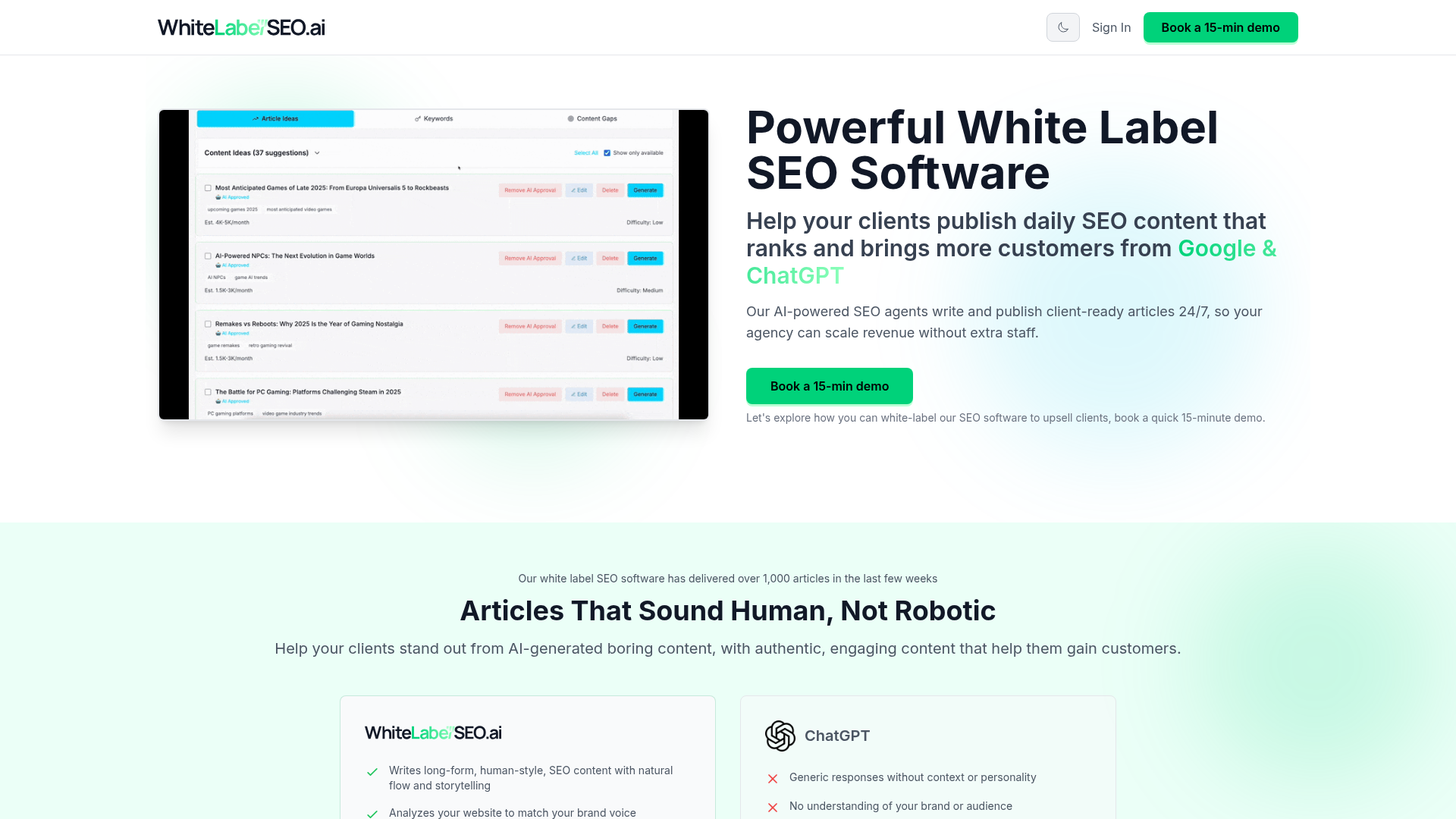
At a Glance
Whitelabelseo.ai is an AI-powered SEO platform built for agencies and growth-focused teams that want to automate content production, improve technical SEO work, and deliver scalable white-label services. In a comparison between an AI SEO platform and an enterprise SEO platform, it stands out by focusing less on enterprise-level complexity and more on practical execution. That difference matters. For agencies, freelancers, SaaS startups, and e-commerce brands, this often means faster publishing, smoother CMS workflows, a more consistent brand voice, and more room to scale without creating operational disorder, which is often where things start to slip.
Core Features
- AI-driven SEO content creation for scalable publishing
- White-label workflow support for agencies and resellers
- Technical SEO optimization capabilities
- CMS integrations that make publishing operations smoother
- Brand voice customization across content outputs
- Content scaling systems for multi-client delivery
- Automation support for ongoing SEO production workflows
Pros
- Built for scalable delivery: It is designed to help teams produce and manage SEO work at volume, which is usually the point where many agencies begin to hit operational limits.
- Strong white-label fit: Unlike enterprise tools that are aimed mainly at internal departments, this platform fits agencies that need client-ready delivery under their own branding.
- AI with practical workflow value: The AI supports real execution across content production and optimization, not only the ideation stage, which is often where many tools stop.
- Brand voice flexibility: Teams managing multiple brands or client accounts can keep output more tailored instead of letting everything sound interchangeable.
- Easier fit for leaner teams: Agencies, startups, and freelancers often need speed and clarity more than extra process layers, and the platform is built around that reality.
Who It’s For
Whitelabelseo is a strong fit for SEO agencies, digital marketing firms, SaaS startups, e-commerce brands, and freelancers that want to automate SEO content and technical workflows while keeping delivery efficient and client-friendly. It feels very practical. It is especially appealing for teams that need white-label capabilities, faster turnaround, and a platform that leans more toward execution than a traditional enterprise suite. If that matches the operating model, the difference will probably become clear fairly quickly.
Why execution-first teams look at AI workflows
Many smaller marketing teams are not looking for another oversight dashboard. They are usually trying to remove delays between planning, drafting, editing, optimization, and publishing. In that environment, workflow automation becomes more important than additional reporting layers. Teams evaluating an SEO automation platform for agencies often care more about throughput and consistency than enterprise governance.
Unique Value Proposition
The main distinction comes down to positioning. Many enterprise SEO platforms are built to help large organizations monitor, govern, and report on SEO at scale. Whitelabelseo.ai is built more directly for teams that need to produce and deliver SEO work at scale. In this context, that distinction matters because the platform sits closer to the actual work of shipping content and serving clients. If a business model depends on turning strategy into output quickly, supporting multiple brands, and streamlining white-label operations, it fits more closely with revenue-generating workflow than with enterprise oversight. In many cases, that means helping teams move from planning to published content and client delivery faster. For modern agencies and fast-moving growth teams, that is a real advantage.
Real World Use Case
An agency managing ten SaaS and e-commerce clients can use Whitelabelseo to standardize content production, preserve each client’s voice, and move drafts through connected CMS workflows more efficiently. This reduces tool sprawl. Rather than juggling disconnected tools and freelancers for every account, the team can build a more repeatable system, deliver on time, improve margins, and keep clients satisfied with steady, consistent output. That usually matters even more when several accounts are being managed at once.
Website: https://whitelabelseo.ai/
2. BrightEdge
At a Glance
BrightEdge is one of the most established names in the enterprise seo platform category. Founded in 2007, it is known for large-scale SEO analytics, technical monitoring, rank tracking, forecasting, content performance tools, and support for enterprise organizations. It has also expanded into AI-driven search capabilities with products like Copilot. In this comparison, BrightEdge represents the classic enterprise side of the market: powerful, broad, mature, and likely a bit more traditional in feel. It seems like a strong fit for large organizations, and it is often better suited to bigger internal teams than to lean agencies looking for flexible white-label automation.
Core Features
- Enterprise SEO analytics and reporting
- Keyword tracking and rank monitoring
- Content optimization workflows
- Site audits and technical SEO tools
- AI search and AI visibility features
- Competitive analysis, along with forecasting
- Large-site monitoring capabilities
Pros
- Enterprise depth: BrightEdge is built for complex websites, layered reporting needs, and executive-level visibility across leadership teams and departments.
- Strong technical coverage: It supports solid auditing and monitoring for large SEO programs, especially when sites are extensive and technically demanding.
- Established reputation: Many enterprise teams already know the brand, which often reduces internal validation friction because less time is needed to explain why it is credible.
- Advanced reporting: Forecasting and performance reporting are notable strengths, particularly in larger organizations with multiple stakeholders involved.
- AI expansion: Its newer AI features help it stay relevant in modern search environments, especially for teams tracking AI visibility and broader search shifts.
Cons
- No public pricing: Buyers need to go through sales, and that can slow down comparisons and make budget planning more difficult.
- Likely expensive for smaller teams: Freelancers, startups, and many agencies may find it outside a practical budget range, which is often a real constraint.
- Heavier onboarding: The platform can be more complex to implement and manage than lighter AI-first alternatives, so teams will probably need more time and stronger internal support.
Who It’s For
BrightEdge is best suited for enterprise marketing teams, large in-house SEO departments, and organizations managing complex websites across multiple stakeholders. It is a strong choice when executive reporting, technical visibility, and broad enterprise coordination matter during planning, reporting, and cross-team decision-making. That is the real focus here. White-label content operations and lightweight scalability matter less in this case. Smaller agencies may still appreciate its depth but decide that it offers more capability, reporting structure, and oversight than they actually need.
Where enterprise governance becomes important
For some organizations, content production is not the primary challenge. Coordination is. Large brands may have regional teams, legal reviews, layered approval systems, and reporting expectations from leadership. In those situations, an enterprise SEO platform often becomes more valuable because visibility and governance affect daily operations.
Unique Value Proposition
BrightEdge’s core value is enterprise maturity. It is built to give large organizations a central layer for search performance insight, technical monitoring, and strategic oversight. In many cases, that has clear appeal for companies with major web properties and internal teams that need coordination across SEO, content, and leadership reporting, rather than a faster, production-focused system, which usually serves a different priority.
Website: https://www.brightedge.com
3. Conductor
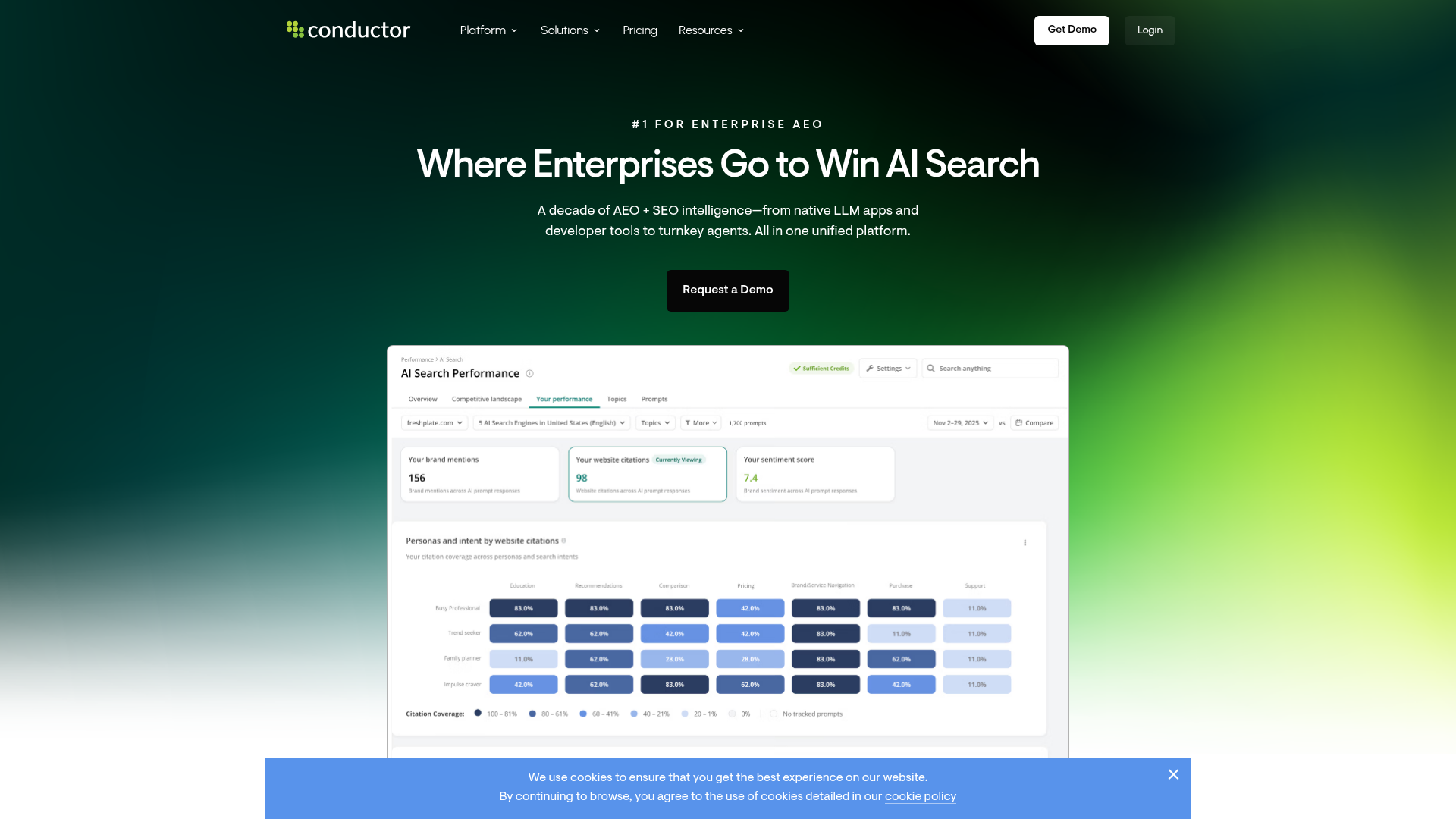
At a Glance
Conductor, founded in 2006, is another established enterprise SEO platform with a strong focus on content intelligence, audience insight, collaboration, and content planning. It is often used by larger marketing teams that want to connect SEO research with optimization and broader planning work. In an AI SEO platform vs enterprise SEO platform comparison, Conductor sits closer to the content-intelligence side of enterprise software, which is probably the clearest way to describe it. That makes it a good strategic fit, especially for larger organizations trying to understand audience demand and measure content performance. At the same time, it remains more enterprise-focused than agency-first, so smaller operators may not find it especially easy to use.
Core Features
- Enterprise SEO monitoring
- Content intelligence and optimization
- Website monitoring and technical insights
- Keyword research and performance tracking
- Audience intent analysis
- Workflow and collaboration features
- Team-oriented content planning support
Pros
- Strong content intelligence: Conductor is particularly useful for teams that want deeper visibility into content opportunities and audience demand. That is probably one of its clearest strengths.
- Good collaboration support: Larger teams benefit from workflow features that help coordinate work across departments, which often becomes important once SEO, content, and leadership are all involved.
- Established enterprise credibility: It has a solid reputation among enterprise marketing organizations.
- Balanced research and optimization: The platform connects discovery with execution more smoothly than some tools that lean more heavily toward reporting.
Cons
- No public pricing: Like many enterprise platforms, evaluating it takes more time and usually involves talking with sales.
- Less friendly for small operators: Solo consultants and smaller agencies may find it too enterprise-heavy.
- Can be overkill: Teams that mainly need AI content production or white-label efficiency may not use its full range of features. In many cases, that means paying for features they probably will not use.
Who It’s For
Conductor is a good fit for enterprise brands, large content teams, and in-house marketing departments that want strong content intelligence connected to SEO planning. It makes the most sense for organizations with multiple collaborators and a structured content operation. It usually works best where content planning involves several stakeholders rather than one person handling everything, and that kind of complexity often becomes noticeable fairly quickly. Agencies looking for white-label automation or a lean AI production engine may find it more strategic than hands-on.
Content planning vs production speed
One of the biggest differences between enterprise-focused tools and AI-first systems is where they create value. Conductor leans heavily toward insight, planning, and coordination. Meanwhile, AI workflow tools are often designed around output velocity. Teams comparing platforms sometimes benefit from reviewing broader guides on content automation platforms for SEO before choosing a category.
Unique Value Proposition
Conductor stands out for combining SEO insight with content intelligence. It goes beyond reporting on rankings by helping teams understand audience intent and use that information to shape content decisions. For larger teams, that is often important because they need shared direction, not just reporting dashboards. The platform helps organizations understand what their audience is looking for and coordinate content planning more effectively across departments. That is what makes it attractive for enterprises that want stronger internal collaboration around SEO-led content strategy.
Website: https://www.conductor.com
4. Semrush
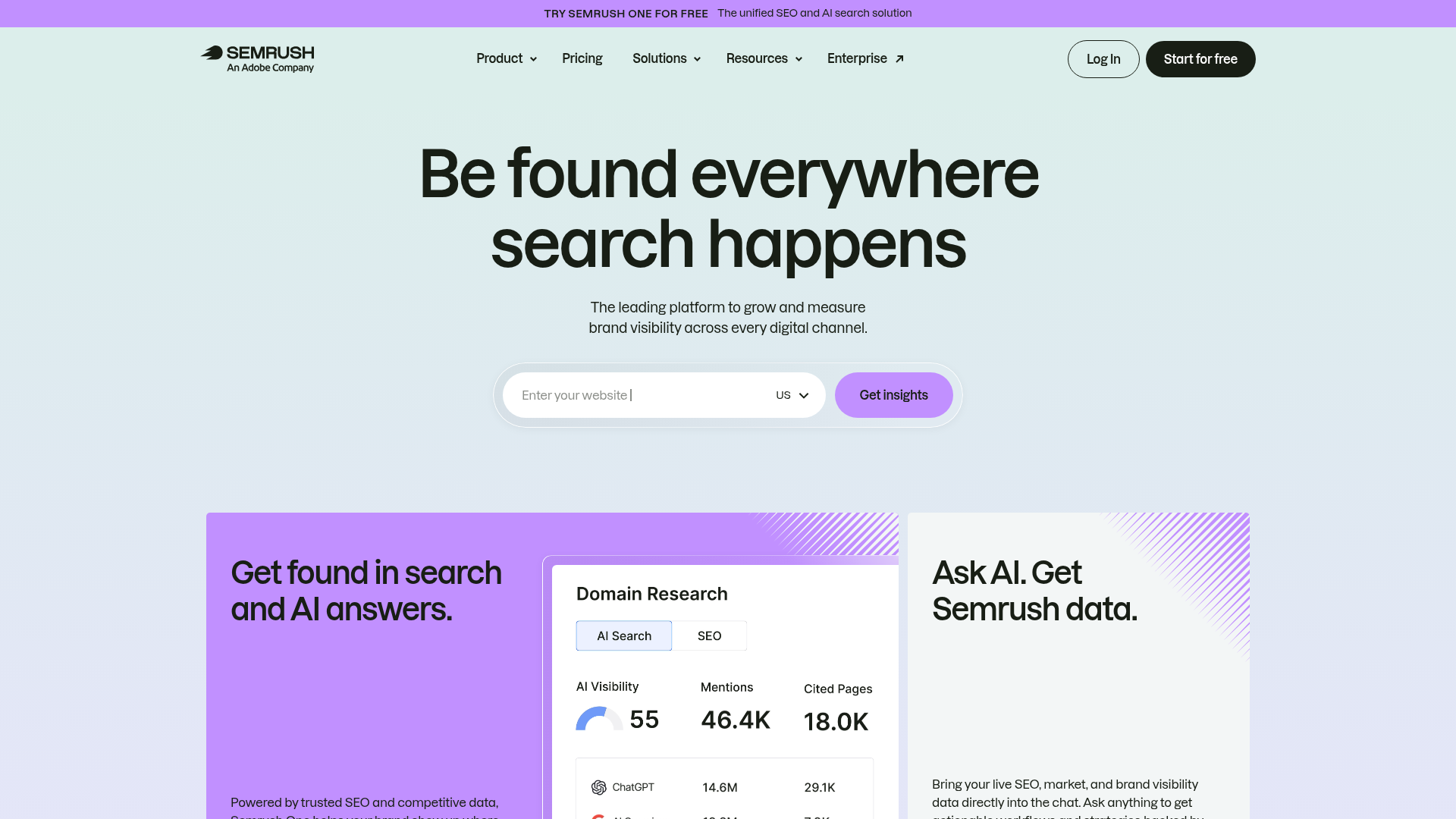
At a Glance
Semrush is a broad digital marketing platform founded in 2008. It often works as an accessible middle ground between a full enterprise SEO platform and a more flexible AI-assisted SEO toolset. The platform includes keyword research, competitor analysis, technical SEO, rank tracking, content workflows, reporting, public plan pricing, and enterprise-level options. That range is a major reason many teams consider it in the first place. For agencies and growing brands, Semrush is often appealing because it offers a large feature set without requiring an immediate move into an enterprise contract. At the same time, costs can still increase as needs grow.
Core Features
- Keyword research and tracking
- Site audit, technical SEO tools, and competitor analysis
- Content marketing toolkit
- AI-assisted SEO and content features
- Reporting, agency workflows, and broader digital marketing integrations
Pros
- Well-rounded platform: Semrush supports a wide range of SEO and marketing work in one place.
- More pricing transparency: Public plans make early evaluation easier than with enterprise vendors that only provide custom quotes.
- Agency familiarity: Many agencies already use it, which can reduce training friction. In practice, that can make adoption smoother.
- Good crossover option: It works well for agencies, in-house teams, SaaS companies, and e-commerce brands.
- Strong ecosystem: The broader toolkit can also support related marketing needs, which often helps teams avoid adding another tool too early.
Cons
- Costs can climb: Add-ons, usage limits, and heavier use can make the platform more expensive over time.
- Less enterprise-specialized: Very large organizations may prefer a dedicated enterprise platform with deeper governance and oversight.
- Feature sprawl: Some teams may end up paying for functionality they do not fully use.
Who It’s For
Semrush is best suited for agencies, in-house marketers, SaaS brands, and e-commerce businesses that want an all-in-one SEO and marketing toolkit with a manageable learning curve. It is especially useful for teams that need flexibility and broad coverage. That wide reach is arguably one of its biggest strengths. Still, it may be a weaker fit if white-label AI content production sits at the center of operations, since that is where the tradeoff becomes more noticeable.
Why hybrid platforms stay popular
A lot of businesses are not fully enterprise and not fully automation-first either. They need research tools, rank tracking, content support, and technical visibility without committing to a highly specialized workflow. That middle ground explains why broad toolkits continue to perform well in the market, especially for growing teams balancing flexibility and cost.
Unique Value Proposition
Semrush’s clearest strength is its range. Teams get a broad working environment for SEO, content, research, and competitive analysis without having to move straight into a heavy enterprise contract. For many businesses, it works as a practical middle ground between highly specialized enterprise systems and narrower AI-first content tools. That balance is often what makes it attractive, especially for teams that want solid coverage without immediately taking on a more complex enterprise setup.
Pricing: Public plans available; enterprise solutions are custom
Website: https://www.semrush.com
Where the real differences show up
A clearer way to compare these platforms is to focus on the job each one is built to do, rather than simply asking which has the longest feature list. Founding year and how clearly pricing is shown will usually reveal that fairly quickly, at least in most cases.
| Company | Founded | Public Pricing | Platform Focus | Best Fit |
|---|---|---|---|---|
| Whitelabelseo | , | No public pricing listed | AI SEO automation + white-label delivery | Agencies, SaaS, e-commerce, freelancers |
| BrightEdge | 2007 | No | Enterprise SEO oversight and reporting | Large enterprises |
| Conductor | 2006 | No | Enterprise SEO + content intelligence | Enterprise content teams |
| Semrush | 2008 | Yes | All-in-one SEO and marketing suite | Agencies and growing brands |
Those details show a meaningful distinction. BrightEdge and Conductor come out of the more mature enterprise SEO era, where a platform often focuses on visibility, monitoring, reporting, and keeping teams working together across the business. Semrush covers a wider mix of SEO and digital marketing needs, with more accessible entry points, which matters when options are compared side by side. Whitelabelseo reflects a newer operating model built to help teams automate and scale output, especially when white-label service delivery is part of how the business runs.
AI SEO platform vs enterprise SEO platform: how to choose the right model
Many buyers get stuck because they compare tools by category label instead of asking which one actually fits the workflow. In practice, an ai seo platform and an enterprise seo platform can overlap, but they usually support different goals, and that is often where the confusion starts.
An enterprise SEO platform often fits better when the environment includes complex sites, multiple internal departments, executive reporting needs, and formal governance. Think large brands with layered approvals, international site structures, and the need to track thousands or even millions of pages. In that setup, detailed reporting and team coordination often matter at least as much as publishing speed, sometimes even more. If the day-to-day work involves cross-functional reviews, regional teams, and regular leadership updates, that is usually the stronger use case.
When AI automation changes the workflow
An AI SEO platform usually makes more sense when execution is the real bottleneck. A team may already know what needs to be published or refreshed, but production keeps falling behind. It may also support multiple clients with different brand voices and separate CMS setups. In other cases, margins are tight enough that hiring more people is not a realistic answer. In situations like these, AI-driven workflow automation often creates more value than extra enterprise complexity. The difference is practical: it tends to help most when the issue is not strategy, but getting drafts, updates, and publishing work done.
That is why Whitelabelseo stands out in this comparison. It is not trying to position itself as the most complex enterprise governance suite available. The focus is on helping teams scale work that actually gets delivered. That means producing, customizing, and moving SEO content through workflows more efficiently, without adding extra process for its own sake. For agencies and SEO-focused service businesses, that distinction usually matters.
A useful rule of thumb is simple: if the main problem is coordination across a very large organization, enterprise platforms deserve a closer look. If the real problem is creating, customizing, and shipping SEO work efficiently, an AI-first platform is usually the better fit in most cases.
What agencies and growth teams should prioritize before choosing
For agencies, teams supporting multiple brands, or lean in-house growth groups, a few criteria usually matter most in this comparison:
- Workflow throughput: Does the platform help the team move from idea to published asset faster?
- Brand control: Can it adapt to different tones, client rules, and content structures?
- White-label readiness: Is it possible to deliver under the team’s own brand without awkward workarounds?
- CMS compatibility: Does it fit the existing publishing setup, or create extra friction?
- Technical SEO support: Can it help with more than content alone?
- Usability: Will the team actually keep using it over time?
- Cost fit over time: Does the value still make sense as clients, brands, or page volume grow?
Questions teams often overlook
Many buyers focus heavily on feature comparisons and overlook implementation reality. A platform may look powerful during a demo but create unnecessary operational overhead later. Teams comparing systems sometimes benefit from reviewing agency SEO tools for content operations because workflow fit usually matters more than the raw number of features.
A lot of companies buy more than they need in this category. An enterprise platform can look impressive at first, but teams often find that they mostly needed faster content production, more consistent delivery, simpler automation, and fewer bottlenecks. That kind of mismatch gets expensive quickly.
A lean SaaS startup with one growth lead, one writer, and a developer probably does not need a massive enterprise command center. By contrast, a multi-client SEO agency that depends on reusable systems and also needs client-specific brand voice control may get more practical value from a purpose-built AI platform than from a heavyweight reporting suite. In situations like these, the deciding factor is often what the team will actually use day to day, rather than what looks more powerful on paper.
Which platform is best for each type of buyer?
Choose Whitelabelseo if: the priority is a strong match for AI-driven SEO production, white-label service delivery, and content scaling with operational efficiency across multiple brands or client accounts, especially when several need to be handled at the same time.
Choose BrightEdge if: there’s a large enterprise SEO program in place and a need for mature reporting, strong oversight, technical monitoring, and executive-level visibility across complex websites. It’s built for scale and is likely best suited to larger organizations.
Choose Conductor if: enterprise SEO is needed with strong content intelligence and closer collaboration across a larger in-house marketing team, which often matters in day-to-day execution. That usually leads to better coordination across teams.
Choose Semrush if: the goal is broad SEO and marketing functionality, public entry-level pricing visibility, and an all-in-one toolkit that can work across different business types, making it useful in more than one setting.
Ready to scale SEO without enterprise bloat?
If you’re comparing an AI SEO platform with an enterprise SEO platform, the main decision is often simpler than it looks: does your team need closer oversight, or is faster output the bigger priority? For agencies, freelancers, SaaS startups, and e-commerce brands, the main pain points are usually slow production, inconsistent brand voice, too many disconnected tools, weak scalability as client volume grows, and rising pressure as content demands increase, which often happens fast.
Whitelabelseo addresses those issues directly. It gives teams a way to automate SEO content creation, support technical optimization, work across CMS environments, and deliver white-label output without the overhead that often comes with enterprise-first platforms. In many cases, that means less time lost moving between tools, more consistent deliverables, and a setup that usually fits day-to-day client work better. It also fits how many modern SEO businesses actually operate, especially when teams are managing multiple accounts at once.
If your team needs a practical platform to scale SEO content operations rather than a heavy enterprise control layer, this is the option I’d start with. You can explore the platform at AI-powered white-label SEO platform and see whether its workflow-first model fits the way your team wants to grow.
Frequently asked questions
Start with workflow fit, not brand recognition. Look at content production speed, technical SEO coverage, reporting depth, CMS integration, collaboration needs, pricing transparency, and whether the platform matches your team size. If you run an agency or multi-brand operation, white-label support and brand voice control should be near the top of your checklist.
If your biggest challenge is enterprise governance, large-site complexity, and executive reporting, an enterprise SEO platform is usually the better fit. If your main challenge is producing and optimizing SEO work faster, an AI SEO platform is often the better answer. For example, Whitelabelseo is more relevant for teams focused on scalable delivery and white-label workflows than for large enterprises buying software primarily for internal oversight.
Pricing varies widely. Enterprise platforms like BrightEdge and Conductor typically use custom sales-based pricing. Semrush has public plans for general use, while higher-tier enterprise options are custom. AI-focused platforms may or may not publish pricing, but what matters most is total operational value: how much labor, time, and delivery friction the platform removes relative to cost.
You can usually see workflow improvements quickly, sometimes within days or weeks, especially around content speed, reporting clarity, and publishing efficiency. Ranking and traffic gains take longer, often several months depending on competition, site authority, and implementation quality. The right platform shortens execution cycles even before organic growth fully appears.
Agencies, digital marketing firms, SaaS startups, e-commerce brands, and freelancers often benefit the most because they need to do more with smaller teams. They usually care about faster production, repeatable systems, and scalable optimization. A platform like Whitelabelseo is particularly relevant when white-label delivery and brand-specific content output are part of the business model.
Not necessarily. All-in-one platforms are useful when you need broad coverage across SEO and marketing tasks. Specialized platforms are often better when one workflow is mission-critical. If content automation, white-label operations, and execution speed are central to your growth model, a more focused platform can outperform a broader suite simply because it solves the main bottleneck better.