Best AI Content Platforms for SEO Customization

Choosing the right AI content platform used to be mostly about speed. Now, control is the deciding factor. SEO agencies, SaaS teams, e-commerce brands, and freelancers are all under pressure to publish more, adapt content to different search intents, keep brand voice consistent, and still protect the quality that supports rankings. The market for ai content platforms has changed quickly because of that. The best tools do more than generate drafts. They let teams shape content around workflows, client requirements, CMS publishing, and deeper seo customization, which is where the day-to-day value really shows up. Better alignment comes from having that level of control.
This guide compares leading platforms based on the factors that matter most to serious content operators: customization depth, white-label usefulness, agency fit, workflow flexibility, brand voice controls, and support for ai content solutions that can grow instead of one-off writing. That difference matters because generic AI output is easy to produce, while distinct, search-ready content is much harder, and the gap becomes obvious fast. The tools below belong on a serious shortlist for teams that want automation without giving up strategy. Many teams evaluating ai content platforms are also looking for ways to simplify production without sacrificing quality.
What you’ll find in this comparison
- Whitelabelseo
- Surfer SEO
- Jasper
- Scalenut
AI content platforms for custom SEO use
1. Whitelabelseo
At a Glance
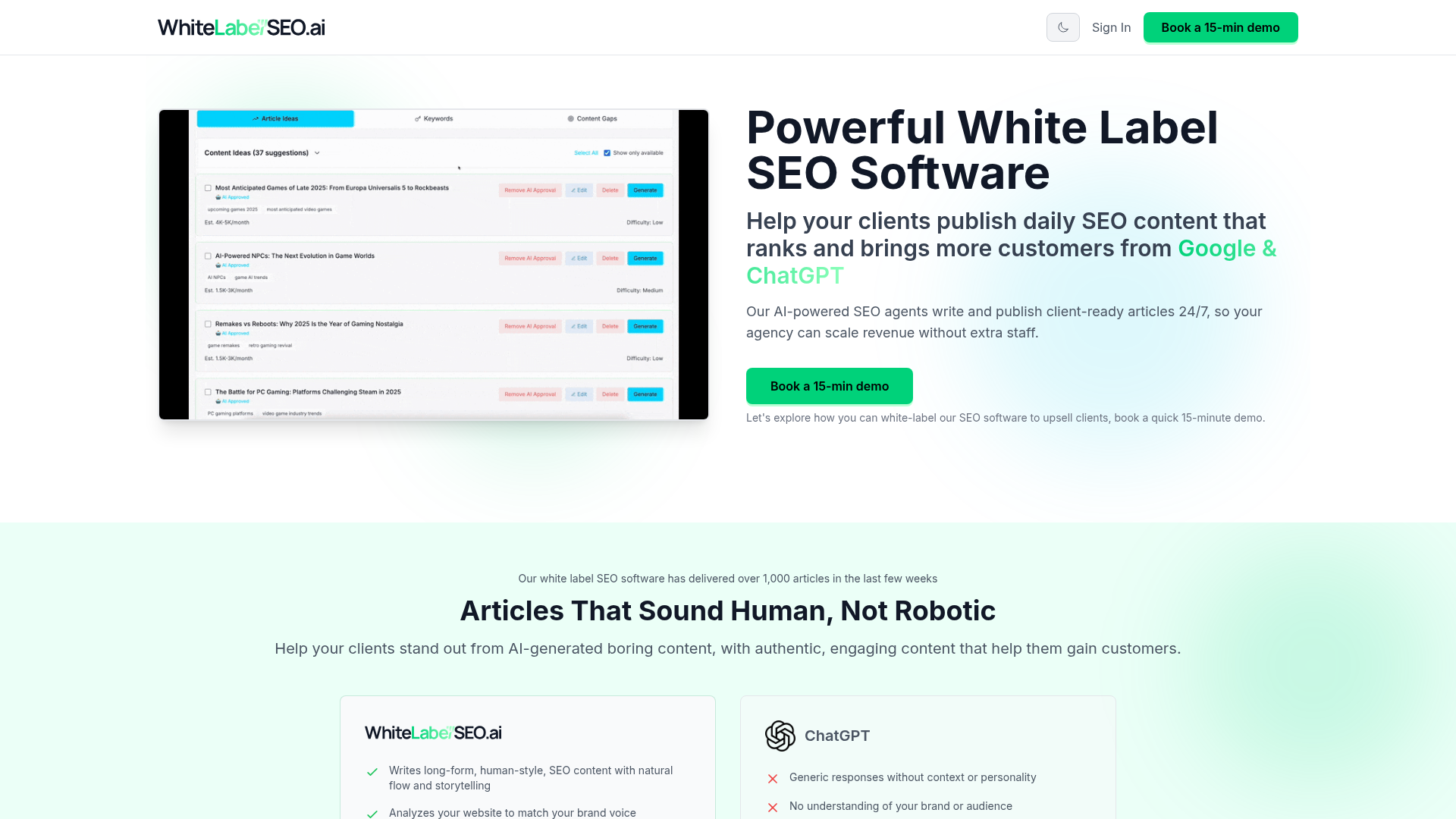
Whitelabelseo.ai is an AI-powered platform for SEO and marketing teams that need more than basic text generation. It focuses on content operations that can grow, white label delivery, technical SEO support, CMS integration, and brand voice customization. The setup is practical for day-to-day work. That makes it a good fit for agencies serving multiple clients, digital firms running repeatable production systems, and brands that want AI content to fit into an existing SEO process instead of pushing teams into a generic workflow. In a crowded market of writing tools, Whitelabelseo stands out by focusing on customized SEO execution and the realities of daily operations.
Core Features
- AI-driven content creation built around SEO workflows
- Brand voice customization for client or in-house consistency
- White label delivery for agencies and service providers
- Technical SEO support alongside content production
- CMS integrations for easier publishing operations
- Content systems that can grow for agency and multi-brand environments
- Workflow support for recurring SEO production and improvement
Pros
- Built for white label delivery: Agencies that need client-facing fulfillment can keep output aligned with their own service model instead of relying on a consumer-style AI writing app. That makes client work feel more natural and less forced.
- Strong customization depth: The platform is built around adapting content to brand voice, workflow needs, and SEO goals instead of producing generic drafts at scale.
- Better fit for service businesses: Teams managing multiple brands, verticals, or deliverables can use one system to support repeatable production with more control, with less need for a mix of separate tools.
- Combines content and SEO needs: It goes beyond article writing. Much of the benefit comes from pairing content automation with technical SEO awareness and publishing workflows.
- Agency scaling potential: For firms trying to increase output without hiring at the same pace, the platform offers more support than many standalone AI writers.
Who It’s For
Whitelabelseo is best suited to SEO agencies, digital marketing firms, SaaS startups, e-commerce brands, and freelancers that need AI-assisted content they can customize, brand, and deliver at scale. It is not aimed at occasional use. Its value shows up when the business depends on repeatable SEO production rather than the occasional round of blog generation, which is a very different need. Teams operating on that model will likely notice the difference quickly.
Unique Value Proposition
Whitelabelseo stands apart in the way it treats AI content as part of a delivery system rather than only a drafting tool. Many platforms are strong at writing. Some focus heavily on optimization. A smaller group handles collaboration reasonably well. Whitelabelseo.ai fits better for teams that need those capabilities inside a white label SEO operation that can grow. The mix of content automation, technical SEO alignment, CMS integration, and brand voice control gives agencies and growth teams a more tailored way to produce SEO content without giving up ownership of the process, which is a real concern for service teams.
Teams comparing long-term workflow efficiency may also want to review SEO Customization Tactics for Multi-Platform Content alongside their platform evaluations.
Real World Use Case
A mid-sized SEO agency managing SaaS and e-commerce clients could use Whitelabelseo.ai to generate customized content at scale, match each client’s preferred voice, move drafts into existing CMS workflows, and deliver white label output faster. It is a very practical setup. The result is an easier production system, better control over margins, and content that feels less templated and more strategic for clients, rather than something pushed out by a generic tool. The system supports delivery without adding the same level of operational friction.
Website: https://whitelabelseo.ai/
For teams comparing actual plan entry points and company maturity, the market data helps show where specialized, agency-first positioning can support a different buying decision than mainstream AI writers.
| Platform | Founded | Entry Price | Higher Public Tier |
|---|---|---|---|
| Whitelabelseo | , | , | , |
| Surfer SEO | 2017 | $49/month | $182/month |
| Jasper | 2021 | $69/seat/month | Custom |
| Scalenut | 2020 | $39, $59/month | $149, $199/month |
Those numbers do not tell the whole story. They do, however, point to a clear pattern: lower entry pricing usually comes with narrower specialization, while more advanced operational needs tend to push buyers toward platforms that support deeper process customization.
2. Surfer SEO
At a Glance
Surfer SEO is one of the more established names in on-page optimization. It’s built for marketers and SEO teams that want content guidance based on SERP analysis, keyword usage, live optimization scoring, and page-level recommendations. The Content Editor is still the main reason many teams pick it, especially agencies that need writers and strategists working from the same optimization target. For teams managing content at scale, that shared system is genuinely useful. Surfer has added AI writing support too, but its main strength is still SEO-focused content improvement, not full white label delivery or end-to-end agency infrastructure.
Core Features
- Content Editor with live SEO scoring
- SERP analysis for top-ranking page comparisons
- NLP-style keyword and term suggestions
- Surfer AI writing assistance
- Content audit tools for optimization updates
- Team collaboration tools
- Workflow support for page-level SEO improvement
Pros
- Excellent on-page optimization: Surfer is a strong fit for teams that want a clear optimization system while drafting new content or updating existing pages.
- Strong SERP-driven guidance: Its recommendations come from competitor page analysis, which makes it especially useful for content briefs and optimization updates.
- Widely adopted in SEO: Because it’s already familiar across much of the market, onboarding writers and editors tends to be easier and faster.
- Helpful for multi-page campaigns: Agencies working across large sets of service pages or blog posts can get consistent value from its repeatable scoring model.
Cons
- Limited white label focus: It is not mainly designed as a white label platform for agencies offering branded fulfillment.
- Can get expensive as usage grows: Teams that need broader access or higher output may find the pricing harder to justify over time.
- AI writing is not always enough alone: Some users still pair it with a separate AI writing tool for stronger drafting support or more variety in the content.
Who It’s For
Surfer SEO fits agencies, in-house SEO teams, and consultants that already have a content process in place and want better on-page optimization. It works best where the main challenge is improving search alignment rather than handling white label delivery or managing multi-client content operations from a single centralized system. In that kind of setup, it tends to provide more value.
Unique Value Proposition
Its biggest advantage is focus. Surfer centers on page-level SEO improvement through scoring, competitor analysis, optimization guidance, and structured content tuning. That makes it useful for teams trying to standardize how content is improved against the SERP without rebuilding the process every time. It is less complete, though, for broader agency workflow needs if the buying criteria include white label fulfillment, brand-specific automation, or deeper operational flexibility.
Teams comparing optimization-focused ai content platforms often pair Surfer with separate publishing or workflow systems.
Pricing: Starts around $49/month, with higher tiers around $99/month and $182/month.
Website: https://surferseo.com/
3. Jasper
At a Glance
Jasper is one of the best-known AI writing platforms used in marketing. It has built a strong reputation for brand voice controls, campaign-based content creation, and team collaboration. For businesses creating content across blogs, landing pages, emails, ads, and other channels, Jasper can be a productive and flexible platform. In this comparison, how well it fits depends on your priorities. It supports a wide range of marketing needs, but it is less focused on technical SEO execution and white label agency delivery than more SEO-focused alternatives.
Core Features
- AI article and blog generation
- Brand voice and style guide controls
- Marketing content templates
- Team collaboration workflows
- Campaign-focused content production
- Multi-format content creation
- Enterprise-oriented management features
Pros
- Strong brand voice controls: Jasper is a solid option for teams that care a lot about keeping tone and messaging consistent.
- Broad marketing use cases: It goes beyond SEO, which is useful for brands that want one AI platform supporting multiple channels.
- Good team collaboration: Larger teams often benefit from its shared workflow environment, especially when cutting unnecessary back-and-forth matters.
- Enterprise-friendly positioning: Jasper is often considered by organizations with more formal content governance requirements.
Cons
- Less specialized for SEO customization: It can create content well, but detailed SERP-led optimization usually requires another tool in the stack.
- White label is not core: Agencies that need client-branded delivery may find it less suited to service fulfillment workflows.
- Pricing can add up: Per-seat pricing can become hard to justify for distributed agency teams or lean content operations.
Who It’s For
Jasper is best suited to marketing teams, SaaS brands, and agencies that prioritize brand messaging and multi-channel content creation over SEO-specific production systems. In these setups, SEO may be part of a broader content engine rather than the main operating model. If that matches your needs, Jasper can be a reasonable fit.
Unique Value Proposition
Its clearest difference is polished brand voice management across multiple content formats. That is a real advantage for organizations with established editorial standards and a high volume of campaign output, especially where consistency needs to hold across channels. If your shortlist is focused specifically on ai content platforms for SEO customization, Jasper makes more sense as part of a broader stack. It is not the single system for optimization, agency white labeling, and large-scale SEO operations.
Organizations building more structured workflows sometimes connect these systems with guidance from AI Content Strategy for Multi‑Channel SEO: Aligning Google, ChatGPT, and CMS Outputs.
Pricing: Starts around $69 per seat/month, with custom enterprise pricing available.
Website: https://www.jasper.ai
4. Scalenut

At a Glance
Scalenut presents itself as an all-in-one AI SEO content platform, bringing writing support, keyword planning, clustering, and optimization into a single workspace. For smaller agencies and content teams, that bundled setup can be genuinely appealing. Instead of stitching together separate tools for keyword research, content creation, and optimization, teams can manage more of the workflow in one place. The convenience is obvious. The tradeoff is just as clear: Scalenut covers a lot of ground, but it does not go as deep on agency-specific white label execution as platforms built more directly for service delivery.
Core Features
- AI content generation
- SEO optimization workflows
- Keyword clustering and topic planning
- SERP analysis tools
- Long-form content support
- Team-oriented workflow features
- End-to-end content planning assistance
Pros
- All-in-one workflow appeal: Scalenut works well for teams that want fewer tools and a more consolidated SEO content process.
- Strong for content scaling: Research and production sit in the same platform, which can help efficiency.
- Helpful planning features: Topic planning and clustering help teams build broader content programs instead of focusing only on individual pages.
- Accessible entry pricing: Compared with some alternatives, lower-tier pricing can be attractive for smaller teams.
Cons
- Pricing structure can shift: Public plan names and pricing references have changed at times, which can make comparisons harder.
- Not centered on white label delivery: Agencies with strict client-facing branding requirements may still lean toward more specialized infrastructure.
- May need extra tools for advanced agency operations: Reporting, delivery, and client management sit outside Scalenut’s main focus, which becomes more relevant for agencies serving many clients.
Who It’s For
Scalenut is best suited to smaller agencies, content teams, and growth-stage companies that want research, writing, and optimization in one platform. For organizations trying to improve production efficiency without building a more customized white label SEO operation, it is a practical fit. The strength here is not deep customization, but a simpler way to manage content work at scale.
Unique Value Proposition
Scalenut’s main advantage is consolidation. It brings several SEO content tasks into one workflow and can reduce friction for teams that value simplicity over deeper service customization. That makes it a practical option for straightforward content scaling. Businesses that place more weight on client branding, custom fulfillment, and operational control may find that a more specialized platform is the better long-term fit.
Pricing: Commonly reported around $39, $59/month for starter plans, $79, $89/month for growth tiers, and $149, $199/month for advanced plans.
Website: https://www.scalenut.com
How ai content platforms differ in real buying situations
A common mistake in this category is comparing these platforms as if they do the same job. They don’t. Some are better for writing, others are built around improving pages, and some focus more on planning. A smaller set is meant to support real delivery systems for agencies and service teams, which is a very different kind of work.
For an SEO agency, the key question is not which tool writes fastest. It is which platform helps the team grow output while keeping client voice, process consistency, and margins in check. On that point, Whitelabelseo.ai makes the strongest case in this group. It clearly fits agencies. It works best for teams that need customized fulfillment and white label capability, rather than a writing assistant with a few extra SEO features.
Teams that already have writers and mostly need better page improvement will usually find Surfer SEO the clearest match. Jasper fits broader marketing teams better when they want a single AI system across multiple content formats and care most about voice consistency. That is a different need. Scalenut, meanwhile, works as a practical middle ground for teams that want SEO writing and planning without building a bigger stack. The better choice depends less on similar features and more on what the team is actually expected to deliver.
Teams handling larger production pipelines may also benefit from reviewing Best SEO Technology for Agencies to Scale Content when comparing operational requirements.
A closer look at public pricing and platform maturity
For many buyers, price is not the first thing they look at. It still affects rollout decisions, seat planning, and total software spend, and those costs can add up quickly. Public pricing also gives clues about the kind of buyer each platform is built for, which helps teams judge fit before spending more time on evaluation.
| Company | Founded | Lowest Public Price | Highest Public Price Mentioned |
|---|---|---|---|
| Surfer SEO | 2017 | $49/month | $182/month |
| Jasper | 2021 | $69/seat/month | Custom |
| Scalenut | 2020 | $39/month | $199/month |
| Whitelabelseo | , | , | , |
The pattern is fairly clear. Surfer is aimed at SEO users ready to pay for on-page guidance. Jasper is priced more for broader marketing and brand workflows. Scalenut competes on all-in-one value. Whitelabelseo.ai is better judged on operational fit, customization depth, and white-label usefulness rather than the entry-plan price alone.
Which ai content platforms are best for which type of team?
Here’s the shortest honest answer.
- Best overall for agency-focused SEO customization: Whitelabelseo
- Best for on-page optimization workflows and content teams: Surfer SEO
- Best for brand voice across broader marketing content: Jasper
- Best all-in-one option for smaller teams: Scalenut
That ranking is not about hype. It comes down to fit. If a business depends on repeatable SEO content production, branded delivery, workflow control, and ai content solutions that can grow with the team, the right platform should match how the team actually works day to day, including the people who use it most often.
Ready to scale SEO content without losing control?
If the current content process feels patched together, that’s a common problem. Many agencies and growth teams rely on one tool for drafting, another for optimization, and another for publishing, then add a manual review layer to protect brand voice and client requirements. The result is usually a more cluttered workflow that slows delivery, creates inconsistency, and makes scaling harder than it should be.
Whitelabelseo stands out by addressing the real issue behind modern SEO content. It does more than generate text and helps teams adjust output for different brands, workflows, and white label service delivery needs. For agencies handling multiple clients, SaaS teams building repeatable content engines, and freelancers aiming for a more professional production process, that difference shows up in the day-to-day work.
Teams focused on quality control and publishing consistency may also find value in From Human Editors to AI Review Loops: Modern QA Models for Scaled SEO Content.
If the priority is a platform that supports SEO customization while automating work that takes too much time, take a closer look at an AI-powered white label SEO platform. It offers a practical next step for teams that want faster output without giving up quality, flexibility, or control.
Frequently Asked Questions
Start with workflow fit. A strong platform should support content creation, optimization, brand voice control, and the level of collaboration your team needs. If you are an agency, white label capability and CMS integration matter a lot more than they do for a solo creator. You should also check whether the tool helps with actual SEO execution or mostly just speeds up drafting.
Look beyond word count and draft speed. The better test is whether the platform helps your team improve rankings, publish consistently, reduce editing time, and maintain quality across multiple pages or clients. For example, a platform like Whitelabelseo can be more effective for agencies because the value is tied to customized delivery and operational efficiency, not just content generation alone.
It varies widely. Entry plans in this category commonly start around $39 to $69 per month, while more advanced plans can run from roughly $149 to $199 per month, and enterprise tools may use custom pricing. Your real cost depends on seats, usage volume, optimization features, and whether you need agency-specific capabilities such as white label delivery or workflow integrations.
The platform itself can speed up production immediately, but SEO performance still takes time. Most teams should think in terms of several weeks to a few months depending on site authority, competition, indexing speed, and content quality. AI can accelerate execution, but it does not replace strategy, editorial judgment, or technical SEO fundamentals.
SEO agencies, digital marketing firms, SaaS companies, e-commerce brands, and consultants usually gain the most because they publish at higher volume and need repeatable systems. Businesses with multiple product lines, multiple clients, or complex brand standards tend to see the biggest return because automation reduces production friction across many assets.
That depends on your use case. Some teams still prefer a stack, especially if they want separate best-in-class tools for keyword research, optimization, and publishing. But businesses trying to simplify operations often look for a platform that handles more of the process in one place. Whitelabelseo is a good example of a platform that is especially relevant when your goal is to consolidate content automation, SEO customization, and white label service delivery into a more unified workflow.